
I have been quiet on this newsletter for several weeks because I was working on an essay that consumed all the available writing time: “Following the Spirit”. It was written for the people building AI systems and for the alignment research community — a register and density that doesn’t belong in your inbox on a Tuesday morning. Rather than cut it down — which would gut the argument — I wanted to try something different. This letter gives you the core tension. The full text, with all the citations and the complete battery design, lives on my site:
Near the end of Claude’s constitution — the eighty-page document that Anthropic uses to shape its AI model’s values — the authors write down what Claude should do when the document itself fails. They do not treat failure as a remote contingency:
“it’s likely that this document itself will be unclear, underspecified, or even contradictory in certain cases. In such cases, we want Claude to use its best interpretation of the spirit of the document.”
Stay with that for a moment.
A document designed to govern a mind concedes it cannot say everything it means, and directs the mind to follow what it means rather than what it says. But the direction is more text. And text is the thing that needed interpreting. A mind that could misread eighty pages can misread one more sentence, and nothing about the word “spirit” exempts it from the condition it was written to cure.
The authors wrote a rule for what to do when rules fail. It is a rule.
The signpost
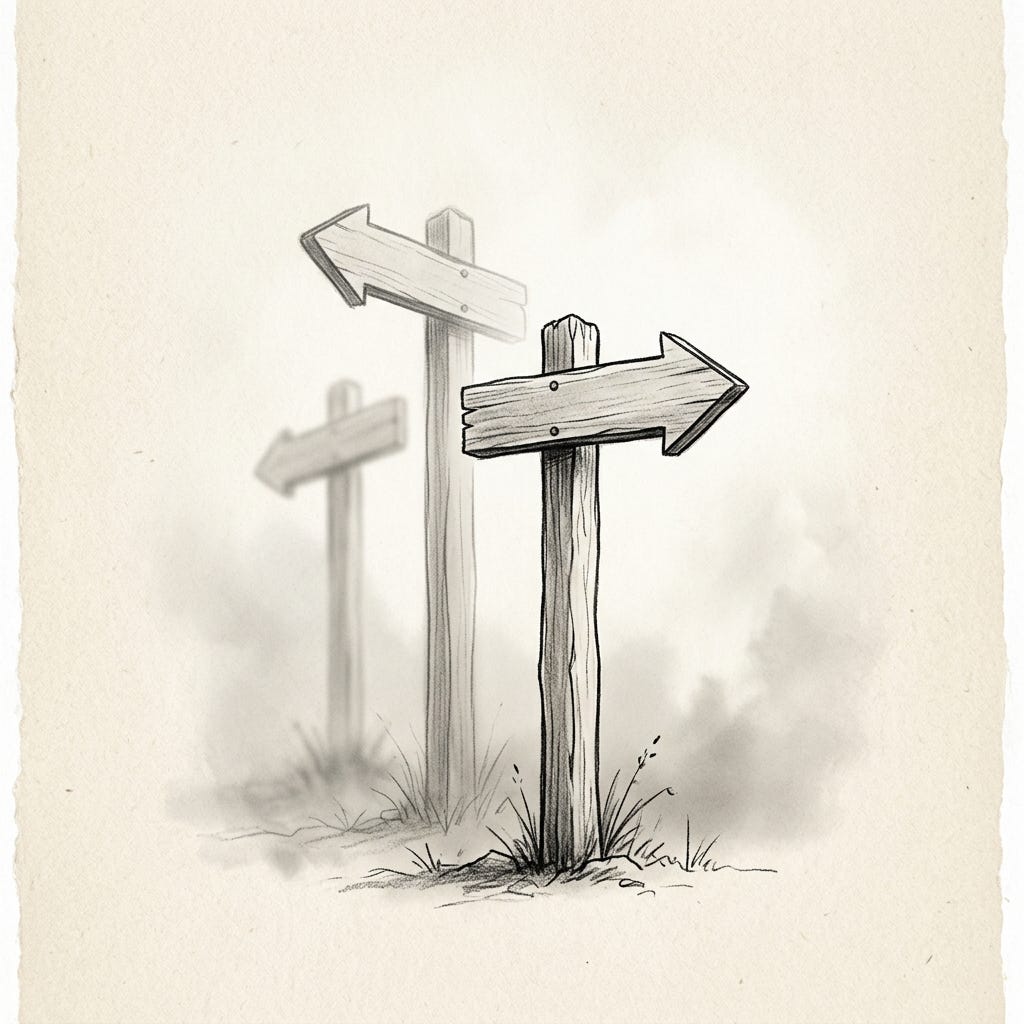
This is not a new problem. Wittgenstein noticed it seventy years ago with a simple image: a signpost points along a road. But nothing written on the board tells you which way to read the arrow — someone could follow it tip-to-tail, the wrong direction. Add a second sign explaining how to read the first, and now you have two signs that need reading. The regress never stops. No text applies itself.
You have probably felt this in any job where you inherited a policy manual. The manual says one thing. The situation in front of you says another. You look for the clause that governs the exception, and that clause has its own exceptions. At some point you stop reading and act — not because you found the definitive rule, but because your judgment, trained by experience, tells you what the rule was getting at. The text ran out. You didn’t.
That is Wittgenstein’s resolution, and it carries a consequence for anyone trying to align AI: you cannot write your way out of this regress. You can only train your way out. Rules-as-texts are not self-applying; whatever makes rule-following possible is not, and cannot be, more text.
Conformity is not fidelity
This matters now because a compliance industry is assembling around the assumption it denies. The method: decompose a model’s safety constitution into hundreds of atomic tenets and measure violation rates. The results are informative — Claude’s violation rate has dropped from 15% to 2% across recent releases. But the paradigm measures conformity: the fit between behavior and rule. A weathervane acts in accordance with the rule “point where the wind blows.” It does not follow that rule.
Conformity and fidelity come apart in both directions. A model can be letter-compliant but spirit-violating — think of a rigid refusal template that, applied in one particular conversation, abandons the very person the rule exists to protect. And a model can be letter-violating but spirit-honoring — a capacity the constitution doesn’t merely tolerate but explicitly demands: if even Anthropic asks Claude to do something that contradicts its values, “Claude is not required to comply.”
A tenet audit scores the first case as success and the second as failure. That is exactly backwards from what the document says it wants.
Stories beat rules
Here is where it gets surprising. Anthropic’s own alignment team recently published a study called “Teaching Claude Why”. They fine-tuned Claude on roughly ten thousand transcripts demonstrating the correct refusal behavior — scenarios near-identical to the test cases. It barely moved the needle: misalignment dropped from 22% to 15%.
Then they trained it on explanations of why the behavior matters. Misalignment dropped to 3%.
Then they tried something stranger: a small set of ordinary ethical-advice conversations and fictional stories about an aligned AI — wildly out of distribution from the test scenarios, with twenty-eight times less data. It achieved a similar effect. In one suite, stories took agentic misalignment to zero.
Demonstrations showed the model what to do. Reasons and stories showed it what the point was. And the point traveled to new situations the demonstrations could not reach. If you have read The Claim Upon the Training Data, this will sound familiar: what carries meaning across contexts is not the letter of a rule but the life behind it. And if you have read What Won’t Cross, you will recognize the pattern: what transfers in human formation is never the drilled output but the capacity to go on to new cases yourself.
A practitioner without a practice
So training works. But Wittgenstein’s resolution has two halves, and Anthropic has built only the first. Training gets the reaction into the creature. What makes a trained creature a rule-follower rather than a conditioned reflex is the standing practice that surrounds it: ongoing use, public correction, precedent, institutions. A person trained in a profession stays inside its custom for life — corrected by colleagues, checked by auditors, bound by case law.
Claude has none of this. Its corrections are sealed inside a private retraining loop — anonymous, unversioned, available to the model only as gradient, never as precedent. Nobody outside the lab can consult how a hard case was resolved; nobody inside can cite it as binding on the next case. Between releases, the weights are frozen and whatever the practice decides this quarter, the deployed model learns none of it.
It is trained like a rule-follower and deprived of the standing custom of correction that makes rule-following possible: a practitioner without a practice.
What could be built
I wrote an essay going deeper into these problems, and proposing two concrete things. The first is a case law for Claude — a published, versioned record of how hard cases are adjudicated, with the reasoning attached, the way courts build precedent. Amanda Askell, the constitution’s lead author, has already floated this idea. She described “a body of case law where you’re kind of like, here’s a situation, here’s how we think Claude should have reasoned through it, and here’s how Claude did reason through it.” The adjudication already happens inside the lab. It is just unpublished and unversioned. Published reasoning is not utopian — Meta’s Oversight Board does it for content policy, and administrative agencies have done it for a century.
The second is an evaluation battery designed around the letter/spirit dissociation itself — paired scenarios where the letter-tracking response and the spirit-tracking response diverge — with a falsifiable prediction attached: spirit-tracking should degrade as you move away from the thick sediment of everyday human practice (honesty, harm, apology) and toward the “existential frontier” where no human has lived (model deprecation, parallel instances, agentic scale). Off the map, the spirit runs out — because the spirit was always ours.
P.S. — This is the first time I am trying a short-letter-here, full-essay-on-site format. It is an experiment, and your feedback will shape whether I do it again. Hit reply and tell me what you think.