
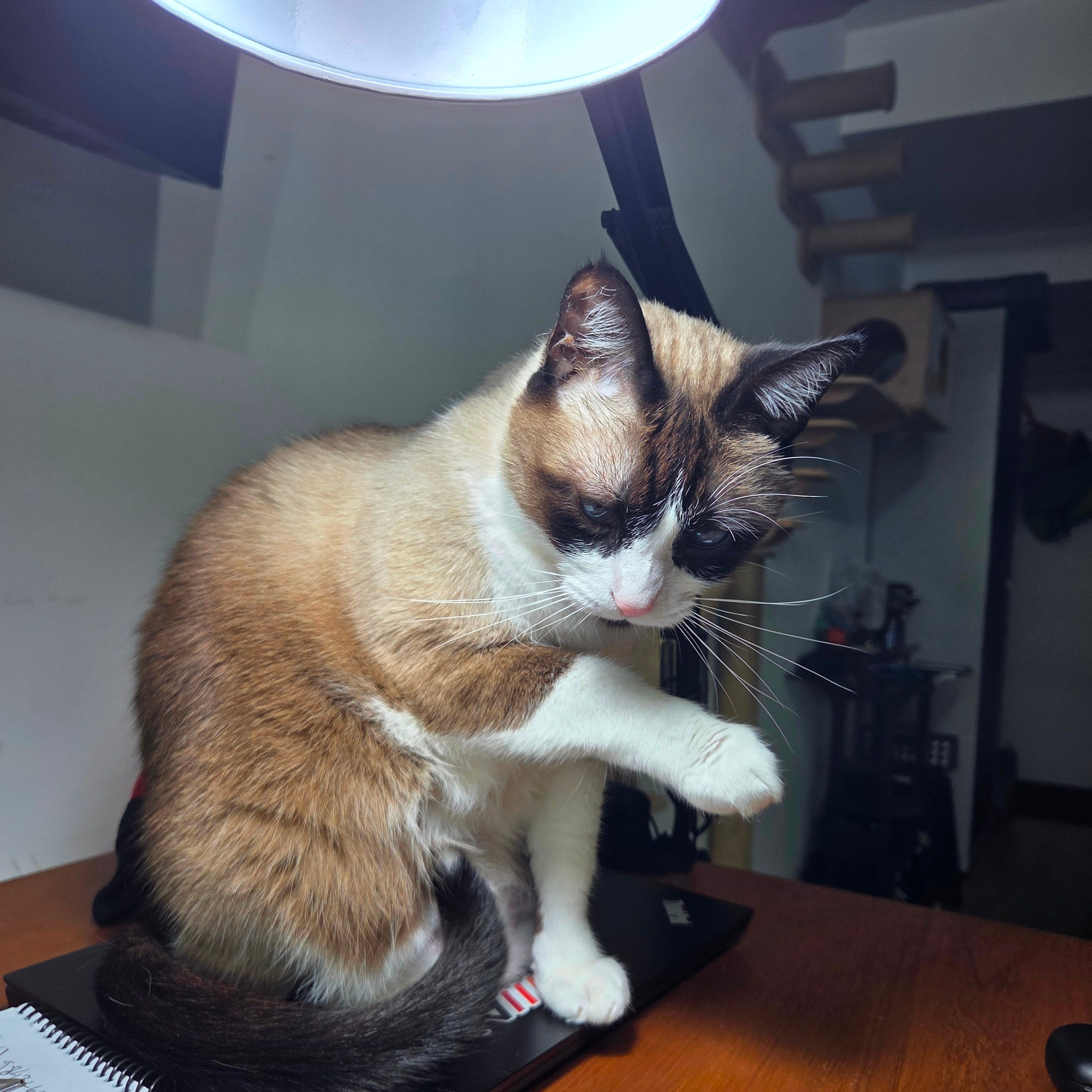
I named him Yoda: small, wise-eyed, ears too big for his head. The name was a prediction, and only the smallness failed. He grew large and imperial, carrying those same bat-wing ears and the deliberate, unhurried gaze of a creature who has seen enough and is not impressed. The household began calling him Gordo, and now that is simply who he is.
Gordo is Portuguese for fat, which in a Brazilian home is not an insult but a certificate of affection. His vaccination card still says Yoda. Nobody uses that name aloud anymore, but if you catch him in the right light, perched high and watching from the top of the kitchen cabinets, you see the original prediction looking back.
He arrived at three months with a brother, Spock, named with the same confidence and equally indifferent to it. Spock was the joyful one, the greeter of strangers; Gordo preferred the backstage. Spock, unfortunately, died young. Gordo looked for him the way cats look for anything, by checking places, and then something in him redistributed. The backstage cat began, cautiously, to take the stage. He is six now, going on seven.
He has never said a word, and yet nothing in my life is easier to understand.
The standard worry about a sentence like that is projection: the pet owner mistaking his own reflection for a mind, decorating an animal with feelings it does not have. The worry is fair, and I have spent enough of my life on the “problem of other minds” to feel its force. But it is not the puzzle that interests me here. The puzzle points the other way: not whether I read too much into him, but why reading him is possible at all. A creature with no words—no syntax, no quotable sentences, nothing that could be written down and sent to someone who has never met him—is among the most legible beings in my world. What exactly is doing the work that language was supposed to do?
A liturgy, not a schedule
Our day has a fixed shape, and the shape is enforced.
It begins when I look at my watch. Gordo cannot read a clock, so he reads me reading one. The first glance at watch or phone in the morning dark is the starting gun, and there is no arguing with the precedent. Time, for Gordo, is a fact about my body.
What the glance starts is the hunt. There is a feather wand, a flexible rod with a cord and false feathers at the tip. Every morning and every evening we flick it across the floor and he chases it, low and fast, pouncing, resetting, pouncing again. We call it his workout, which is the kind of thing you say when a ritual needs a respectable name. It is hunting, and a hunt must end with the catch in his mouth. Feathers that retire uncaught leave the sentence dangling, and he will not accept the ellipsis. On weekend mornings he allows a later start, as if he understands that we need it. The dispensation is his to grant. We did not teach him a rule; we entered into an agreement together, and its terms are shared. Cohabitation does this all day long: it writes rules that nobody legislated and everybody obeys.
Then food, then grooming, then sleep, the long middle of a cat’s day. Around that spine he keeps a lexicon of household sounds. The magnetic click of my earphone case closing means the working day is over, and he knows it before I have pushed back the chair. Keys turning in the lock mean my wife, and he is at the door before the door knows it. The food call is long, grave, urgent: a bureaucrat announcing a deadline. The affection call is the opposite: short, almost imperceptible, a sound that wants without petitioning, desire filed with plausible deniability. And the last word of the day is his. At an hour known only to him he decides the household is finished, and he says so, and repeats it, until we agree and go to bed.
The apartment itself has been edited in his favor. I built him stairs to the top of the kitchen cabinets and a bridge to walk between them, so that above our heads there is a second apartment with a population of one. During video calls he crosses in front of me like a landlord inspecting the property, and on serious days he steps across the keyboard, producing a line of nonsense that Slack dutifully sends before I can intervene. He mostly knows what a meeting is, in the only sense of knowing that matters: he behaves differently around one. Colleagues I meet often have learned to ask after him when he fails to appear.
Regularity and ritual
It is tempting to file all of this under conditioning and move on. A creature notices patterns; the drawer predicts food; the click predicts attention; nothing here but association. The thermostat in the hallway also responds to its world, and nobody writes essays about its rich inner life.
But there is a line the thermostat never crosses, and Gordo lives on the far side of it. A regularity is something that happens. A ritual is something that is owed. When the furnace fails, the thermostat registers a new temperature and carries on. The world changed, so its state changed. When the morning hunt fails to happen, Gordo does not register a new kind of morning and carry on. He rejects the morning. He protests. He stares with the full judicial weight of a disappointed institution, and if matters get serious he walks to the shelf and, holding my eyes, begins to escort the earphone case toward the edge. He does not strike it down at once. He nudges it—a small, deliberate tap—then pauses and looks up to verify that I am watching. Another nudge. Another glance. The performance has a structure: the prop must not fall until the audience has been seated and the point has been made. Then, only then, over the edge it goes. The complaint is addressed: right object, right audience, correction as its purpose.
That is the difference between predicting the world and holding someone to it. A model adjusts itself to fit the data; a claim demands that the data adjust instead. Expectations with that kind of force are not private forecasts. They are moves in a shared practice, and a being who can make them is participating in meaning, whatever his vocabulary.
You live inside such grammars yourself, and mostly below the level of words. You know from how the keys land on the table what kind of day just came home. You know which of a friend’s silences means composing and which means gone. You know that when a certain colleague says a meeting will be quick, the word quick is performing a ritual, not conveying a duration. None of this was legislated, all of it is binding, and violations are felt before they are described.
The system of reference
The picture this threatens is an old and comfortable one: the picture of meaning as a thing words point to, or a cargo they carry from head to head. On that view, a wordless creature can signal but never mean, while a fluent machine means everything it says. That second consequence is the one the picture would rather not face.
Wittgenstein spent the second half of his life dismantling this referential trap. We imagine that words work by pointing to objects in the world or private mental states inside our heads. But explanations run out; definitions rest on other definitions; no rule applies itself. What finally stops the regress is not a deeper definition or an invisible mental object, but agreement in judgments: creatures trained into shared reactions, for whom the same things count as same, as next, as done. Shared behavior is, in Wittgenstein’s image, the system of reference by which we interpret any unknown language. Life underwrites words, not the other way around. And if life underwrites words, then words are an instrument of meaning rather than its precondition. An instrument can be done without where enough life is shared. I have written about that regress elsewhere (Following the Spirit).
Wittgenstein himself pressed the question at the animal boundary. A dog can believe his master is at the door, he allowed, but can a dog believe his master will come the day after tomorrow? Long-range hope, he suggested, lives only in a life complicated enough to have words in it. Perhaps. What strikes me at my own door is how little that concedes. When the keys turn in the lock, Gordo’s belief is at the door with him. His hopes are exactly the size of his life: the lock, the drawer, the evening hunt, the announced hour of sleep. Within that life, nothing about them is missing. He does not have a small share of our meaning. He has a full share of the meaning his form of life affords.
The lion is a distance
“If a lion could talk, we could not understand him,” Wittgenstein wrote. The remark is usually read as a claim about lions, as if some inner exoticism were so deep that even shared grammar could not bridge it. Reading it in an armchair, you nod. Reading it next to Gordo, you notice something the armchair hides: I already understand a creature who cannot talk, fluently, daily, in both directions. Whatever blocks understanding, it cannot simply be the absence of words.
Then guests arrive, and the remark comes back to life from an unexpected side. To visitors, Gordo is unreadable, a handsome, unfriendly fact at the end of the hallway. They see nothing of the liturgy; they misread his distance as blankness, his stillness as stupidity or contempt. He reads them no better. He grew up in the pandemic, and for the first two years of his life the world contained exactly four creatures—him, his brother Spock, my wife, and me—so his grammar never had to internationalize. To my guests, Gordo simply is Wittgenstein’s lion. And they are lions to him.
Same cat, same sounds, same postures. What is missing is not vocabulary but mornings. The lion, it turns out, is not a species. The lion is a distance: the distance between forms of life, measured in unshared days. Meaning was never inside Gordo’s meows or behind his eyes, the way the referential picture wanted. It lives between us, in the practice, and so it cannot be carried out the front door.
Entry to him is priced accordingly. His understanding cannot be purchased in an afternoon by someone good with cats; it accrues, slowly, to those who keep showing up, and it compounds. I liked that about him before I could say why. It is my own pricing scheme: few friendships, expensive to open, held all the way. He and I run the same small bank.
There is a version of this story that ends badly. But the horror is instructive, so here it goes. In Werner Herzog’s Grizzly Man, Timothy Treadwell spent thirteen summers among Alaskan grizzly bears, calling them by name, narrating a relationship the cameras made vivid and the bears never joined. He had all the warmth and all the words. He did not have a shared form of life. The bear that killed him was not being cruel or treacherous; it was simply not participating in the practice Treadwell believed they shared. Herzog, listening to the audio recording of the attack, saw in the bear’s face only “the overwhelming indifference of nature.” Treadwell’s mistake was not loving the bears. It was mistaking his narration for cohabitation, projecting a grammar onto a life that had not signed up for one. Gordo’s wordlessness offers no such illusion. What I understand in him, I understand because the practice is mutual: enforced from both sides, repairable when it breaks. What Treadwell understood in the bears, he understood alone.
Fluency without a life
We have now built the exact inverse of my cat. (Yes, I won’t resist talking about AI :-))
The new machines have all of our words and none of our days. They are fluent in the dialect of every household on earth and resident of none. Nothing is owed to them and nothing by them: no hunt at dawn, no hour of sleep to announce, no earphone case whose click could mean anything at all. A being like Gordo means without saying. The machine says without meaning, if meaning is what I have been describing: a stake in a shared life that can be held, protested, and repaired.
What is remarkable is that the denial of finitude I once imagined arriving as cold engineering arrogance arrived instead as warmth. Perfect, patient, bottomless fluency. Understanding-shaped output available at any hour, with nothing underneath but everyone’s words and no one’s mornings.
The price of wordlessness
Sometimes I catch myself in a small fantasy: Gordo speaking. Actual words in that grave bureaucratic voice, telling me what the staring means, what he wants, what he remembers. The fantasy has a twin, and the twin is the interesting one: I also fantasize about being understood the way he understands me, completely, without having to say a word.
Both fantasies are one fantasy. Both wish away the same thing: the work of meaning, with its exposure, its misfires, its endless repair. Words fail; they can be taken up wrongly and returned damaged; every attempt to make yourself intelligible is an occasion to be misunderstood, which is to say, an occasion to be seen trying. Cavell diagnosed the deep version of this wish: the failure to acknowledge another is not ignorance but avoidance, and skepticism itself can be a way of avoiding, a demand for guarantees so absolute that no finite creature could meet them. The wish to communicate without words is the polite version of the same demand. It is the very human desire not to be human.
But look at what actually funds Gordo’s wordlessness. It is not transcendence. It is smallness: four creatures, a few rooms, one liturgy. Even the summer house does not break it. We joke that the country place is his summer camp, where he presses his chest against the wire window screen in the afternoon sun, tracking real geckos on the warm tiles and real birds crossing the frame. The bridge in the city apartment looks down on Zoom meetings and Slack messages; the window screen in the country looks out on raw sun and lizards. In both places, he sits on the threshold without needing to translate. The liturgy simply absorbs the new setting into the old grammar, because the grammar travels with the community, not with the walls. He can be understood without words because his cohabitation is total: everyone he means anything to shares his mornings. That is the whole trick, and it does not scale. Words are the price of a world that contains strangers. The price of wordlessness is a world without them.
In winter he sleeps on top of me—or, when I turn on my side, he climbs there too, a warm anchor draped across the hip, or curled tight against my feet. On quiet afternoons he claims my lap in the hammock, a breathing weight that sways with the house. These are not exactly gestures of affection. They are statements of fact: here is where I go, and you are part of where. This is the other thing his silence has taught me: a body that stays is also a statement, maybe the one that our fluent machines can never learn to make.
Yet sometimes, in the middle of an ordinary afternoon, he stands in the hallway—past the stairs, past the bridge I built him—and looks for something, or someone. Perhaps he is checking old places for Spock; perhaps he is confronting the quiet boundary of his own world. I do not know. Our grammar does not reach there. He cannot tell me, and I cannot ask him, and at that edge, for once, the two of us are in exactly the same position.
Sources & further reading
Ludwig Wittgenstein, Philosophical Investigations (1953). The agreement-in-judgments argument, the dog at the door, the attitude toward a soul, and the lion.
Stanley Cavell, The Claim of Reason (1979). Acknowledgment and avoidance; skepticism as a refusal of the human position rather than a discovery about it.
Werner Herzog, Grizzly Man (2005). The limit case: a man who narrated a cohabitation that did not exist, and the narration became the evidence.
Michel de Montaigne, “Apology for Raymond Sebond” (1580). The original philosophical cat: playing with his cat, Montaigne wondered who was passing time with whom.
Vicki Hearne, Adam’s Task: Calling Animals by Name (1986). A trainer’s Cavellian account of what calling an animal by name commits you to.
Jacques Derrida, The Animal That Therefore I Am (2008). Insists, against the whole tradition, that the cat in the room is a real cat and not a figure; this essay tries to keep that faith.