
This is The Fiction Layer — essays on AI, language, and the infrastructure of meaning. However you found this, welcome. The essay below is a good place to start.
“If the computer and robots can do everything better than you, does your life have meaning?”
Elon Musk posed this question, and to his credit, he did not pretend to have the answer. It is an honest question. It may also be the wrong one.
I spent twenty years in philosophy departments where no machine was coming for my job. And yet the question of what gives a life meaning was not, for me, a thought experiment. I lacked nothing: I had positions, publications, the respect of people I admired. What I had, underneath it all, was what Thoreau once diagnosed in his Concord neighbors: a “quiet desperation” that had nothing to do with scarcity. I kept orienting my work toward what my peers considered valuable, publishing in the journals that conferred standing, pursuing the grants that signaled seriousness, without ever quite asking whether these were the things *I* wanted. The desire was real. The origin was not where I thought it was.
What unsettled me was not the threat of obsolescence. It was the suspicion that what I wanted had been shaped, from the start, by what the people around me wanted. Musk’s question locates the threat in machines. But the harder problem may be older: that the wanting itself was borrowed, long before any computer entered the picture.
There is a famous image from Maslow’s hierarchy of needs that every management consultant has shown, at some point, in a PowerPoint deck. The pyramid sits wide at the base: physical needs, safety. It narrows upward through belonging, esteem, and self-actualization.
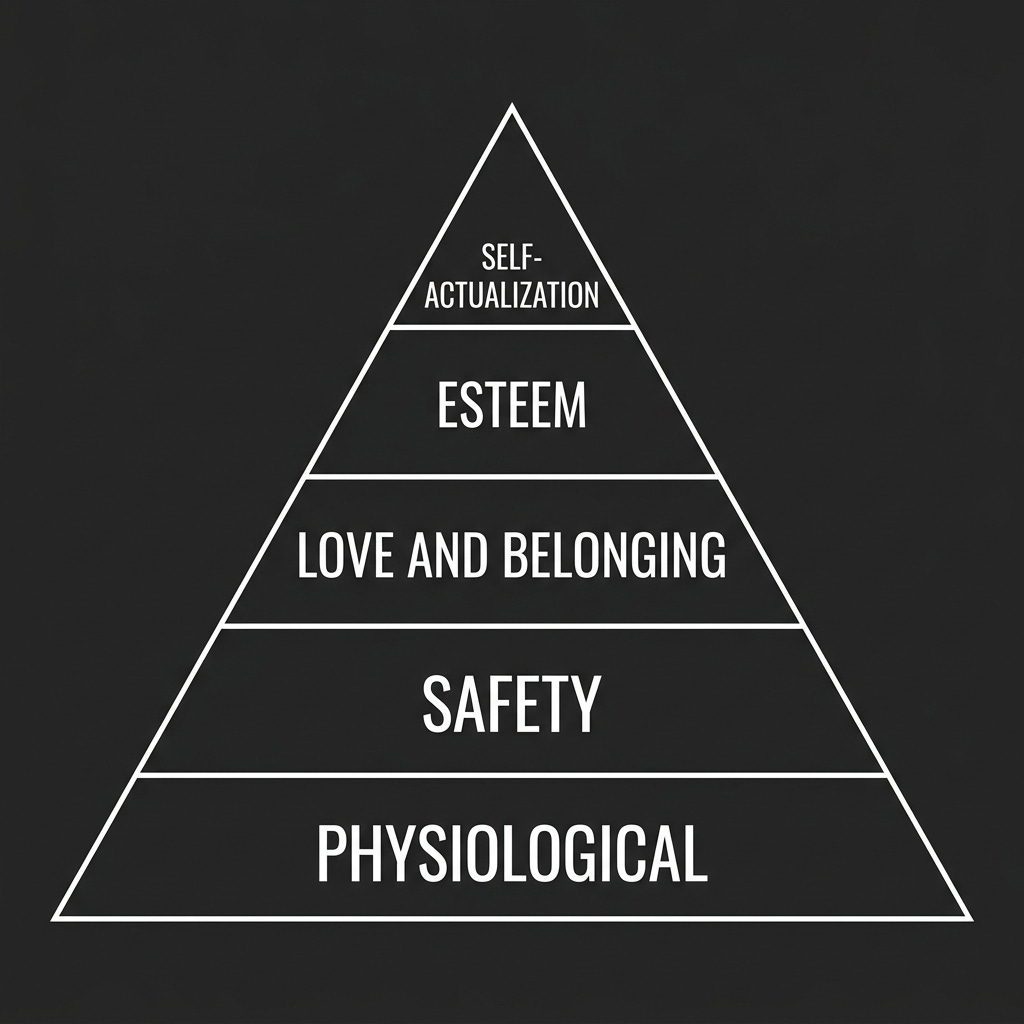
Musk’s question lives at the top of that pyramid, in the realm where people who have everything still feel that something is missing.
But the pyramid contains a hidden assumption, and the question inherits it without examining it: that we already know what we want, and the only difficulty is getting it.
René Girard spent his career dismantling this assumption, though he never used slides.
The finite and the infinite
Sam Altman published an essay in 2021 called “Moore’s Law for Everything.” It is a remarkable document: precise, optimistic, and more economically sophisticated than its detractors give it credit for. His core argument is that the marginal cost of intelligence is about to fall toward zero, just as the marginal cost of electricity, computation, and communication did before it. When that happens, the price of goods and services will collapse, and the current system of labor, wages, and capital allocation will need to be redesigned from scratch. He is not naively utopian about this: he worries explicitly about distribution, proposes a form of wealth tax on capital and land to fund a universal dividend, and acknowledges that the transition will be disruptive before it is liberating. His ambitions are large but the argument is careful.
Musk makes a related case with characteristic sweep: a post-scarcity world, humanoid robots, money as a relic. He invokes Iain M. Banks’s Culture novels, a science fiction series about a civilization managed by benevolent AI where nobody lacks for anything and the concept of a price has become quaint. What Musk does not mention, and what Banks understood, is that the Culture novels are not celebrations of abundance. They are studies of what abundance leaves unsolved. The most compelling stories in the series follow characters who have everything the material world can offer and find themselves seeking purpose through competition, espionage, and borrowed missions at the civilization’s edges. Banks solved the problem of scarcity in fiction. Then he wrote novel after novel about what remained.
Neither Altman nor Musk pauses long on what comes after. They assume, reasonably enough, that a world where food, shelter, healthcare, and physical safety are available to everyone at near-zero cost is a better world. This is almost certainly true, and the ambition deserves to be taken seriously. But solving material scarcity is one thing. Transforming the conditions under which human desire operates is another. It is the second question they leave open, without quite noticing they have left it.
Altman’s essay is, at its core, about need: the cost of the things we require, and the mechanisms by which those costs might fall toward zero. What we want (the desires we construct by watching one another, by imitating, by positioning ourselves relative to models we did not consciously choose) falls outside the frame of his analysis. Not because he is careless. Because no engineering framework easily accounts for it.
Call what they are solving the material problem: human suffering caused by the inadequate supply of goods. The question Girard opens is whether solving the material problem also resolves the problem of human wanting, or whether it merely reveals it.
The fog before the flood
Tyler Cowen’s recent The Marginal Revolution is, among other things, an elegy for the discipline he has practiced for forty years. The book traces how AI is transforming the very methodology of economics: the intuitive, humanistic tradition of marginalist thinking being displaced by machine learning and brute empirical power. But woven through that argument is a sustained diagnosis of why this transformation will diffuse through human institutions far more slowly than the technology itself develops.
Cowen’s case, developed across this book and in conversations like his exchange with Dwarkesh Patel, is that those who build AI and those who study the diffusion of technology are not the same people. The AI researchers are extraordinarily intelligent; they are also, in his diagnosis, systematically prone to projecting the speed of the technology onto the rest of human civilization. As AI makes some sectors radically more productive, resistant sectors (healthcare, education, government, the courts) absorb the disruption unevenly. The economy does not accelerate uniformly; it drags. Cowen has estimated that AI will add roughly half a percentage point to annual growth. Over thirty years, that compounds into something transformative. Year over year, it feels like almost nothing.
Here is what Cowen’s diagnosis implies, though he does not state it this way: the resistance is not primarily technical. Organizations do not sit out the AI transition because the tools are insufficient. They sit it out because adopting the tools would require abandoning the ways of working that define who they are relative to their peers.
The legal firm that resists AI document review is not protecting efficiency; it is protecting an identity that nobody at the firm consciously chose. The model of what a prestigious law firm looks like (the billable hours, the associate hierarchy, the particular forms of deference and display) was absorbed from peer firms, from the profession’s mythology, from decades of watching what success looks like in the eyes of others. The hospital administrator who slows down algorithmic diagnostics is not confused about the data; she is navigating an institution whose hierarchy was built on inherited models of medical authority that the AI threatens to make visible as contingent. This is friction, yes, but friction of a specific kind: the resistance of inherited desires to being exposed as inherited.
Into this fog steps Salim Ismail, the strategist behind Exponential Organizations. In an episode of Moonshots (alongside Peter, Dave Blundin, and Alex Wissner-Gross), he made a prediction that surprised his hosts: consulting firms would not be disrupted by AI. They would have their biggest boom ever. His reasoning invoked an old proverb: in the land of the blind, the one-eyed man is king. If you are a consultant who knows how to use AI tools even slightly better than the terrified CEO across the table, you are invaluable to them. In the epistemological chaos of a technological transition, the scarcest resource is not intelligence or capital. It is orientation. Organizations in the fog are not searching for a better tool; they are searching for someone who can tell them which direction to face. A model to imitate.
Cowen supplies the theory of why the fog exists. Ismail describes the mimetic market that forms inside of it.
The fog itself is a clue. The resistance to the new technology is not ultimately about the technology. It is about the desires that the old arrangements helped organize: the identities, the hierarchies, the models of prestige that people absorbed without choosing them. What Cowen describes as institutional friction and what Girard describes as mimetic desire are not two phenomena observed at different time horizons. They are the same phenomenon observed at different scales.
But suppose the fog eventually lifts. Suppose Altman and Musk are right about the destination, only Cowen is right about the timeline. The flood does arrive. The material problem is solved.
What are we left with?
The pyramid, inverted
Here is what Girard’s theory reveals about Maslow’s pyramid, and what Luke Burgis, the writer who has done most to translate Girard into contemporary terms, makes explicit in Wanting: the pyramid gets the shape wrong.
The base is real. Biological needs are finite and autonomous. If you are dying of thirst in a desert, you do not need anyone to tell you that water is desirable. The need arises from within, from the body’s own urgency, and it has a clear endpoint: you are no longer thirsty.
The upper layers are nothing like this. Belonging, esteem, self-actualization: these are not smaller than the base. They are larger, potentially infinite. They do not narrow to a peak. They open outward. And they belong to the realm of desire, not need. Desire, in Girard’s account, is not autonomous. It is mimetic: it arises from the other.
We do not know what to want. Or rather: we know that we want something, but knowing what to want is almost infinitely harder than knowing what we need. The thirsty person in the desert does not require a model. The ambitious person in a stable society, a person whose physical needs are met, whose safety is guaranteed, does. They look at what the people around them are pursuing, and they pursue it. Not out of stupidity or weakness; out of the structural conditions of desire in a social species. We read our own wants from the faces and choices of others. We desire the being of the other: not just their objects, but their position, their distinction, the particular way they seem to have found their footing in the world.
This is what Girard called mimetic desire. It is contagious, rivalrous, and, in principle, without limit.
There is a finite number of things a person needs. There is no natural ceiling on what a person can be made to want.
If you have read this far, you have almost certainly experienced this. The promotion you wanted until a colleague got it and you wanted it twice as much. The project you lost interest in until someone else picked it up. The career path that felt like a free choice until you noticed that everyone you admired had made the same one.
When the base is secured
The Girardian argument does not diminish the importance of solving material scarcity. On the contrary: the relief of genuine physical suffering is one of the most morally serious things a civilization can pursue. But it reframes what solving that problem achieves. Eliminating the lower layers of the pyramid does not reduce the pressure of the upper layers. It concentrates it.
When you no longer have to spend your attention on survival, you spend it entirely on belonging and esteem and self-actualization, which means you spend it on watching what others have and want and seem to be, and adjusting your own wanting accordingly. The mimetic pressure does not diminish. It intensifies, because it now operates without the absorbing constraint of necessity.
Consider what already happens in societies that have, by historical standards, largely solved the material problem. The most visible anxiety in wealthy communities is not about food or shelter. It is about college admissions: specifically, which university a child attends. The object is desired not because a Harvard diploma provides meaningfully better education than a dozen other institutions but because others desire it. It confers a social position that others can see. Obtaining it registers as a win in a competition whose stakes feel existential precisely because they are positional rather than material.
As material abundance spreads, the competition for scarce positional goods (by definition resistant to abundance) intensifies rather than eases. The pressure does not dissolve. It migrates.
The FIRE movement (people who achieve financial independence and retire before forty) has documented this shift from the inside. Their forums are full of posts from people who solved the material problem ahead of schedule and then wrote, with more honesty than they perhaps intended: “I achieved everything I set out to achieve. Now what?” They solved for need. The question of what to want turned out to be a different problem entirely, and not a smaller one. Thoreau went to Walden Pond to escape this. The FIRE community discovered, a century and a half later, that you can retire to the pond and bring the desperation with you.
Peter Thiel, who studied under Girard at Stanford and has since made Girard’s framework central to his public thinking, grasped this in his analysis of competition in Zero to One. His argument is that companies obsessed with their rivals end up duplicating each other to death; the only escape is to find the position no one else is occupying. This is Girardian economics applied to the technology industry, and Thiel is honest about the source.
The larger implication runs in the same direction: a world of material abundance is not a world without competition. It is a world where competition has been liberated from its material constraints and floods entirely into the immaterial domain.
That domain has no price mechanism to clear it. It has no scarcity that resolves by filling. Satisfying hunger makes you less hungry. Drawing closer to a mimetic rival makes you want to surpass them more, not less.
Remove the necessary work constraint from human life and you do not produce rest. You produce the acceleration of mimetic rivalry in the pure register of status, recognition, and cultural influence. What this essay’s opening described at the scale of a single career, and what Cowen’s analysis describes at the scale of institutions, the courts of early modern Europe enacted at the scale of an entire class.
The clearest case is Versailles. In 1682, Louis XIV moved the French aristocracy to his palace and, in doing so, ran one of history’s most complete experiments in removing material anxiety from an entire class. The nobles at Versailles wanted for nothing: they were housed, clothed, fed, entertained. Every physical need was met by the Crown. What filled the vacuum was not peace, not leisure, not philosophical contemplation. It was the most elaborate system of status competition Western civilization had ever organized. Who stood closest to the king at the levée. Who held the chemise during the royal dressing. Who sat and who stood at dinner, and in what order, determined by precedents so intricate that the Duc de Saint-Simon devoted thousands of pages of his memoirs to cataloguing them. People ruined reputations, destroyed alliances, and fought duels over questions of precedence that had no material consequence whatsoever.
Versailles was a post-scarcity society, at least for the people inside it. And it did not produce contentment. It produced a war conducted entirely in the register of meaning, without the moderating friction of survival. Every ounce of human attention that had once gone to the practical demands of managing estates and commanding local authority was redirected, with extraordinary intensity, toward the single question of where one stood in the eyes of others.
The pattern did not end with the ancien régime.
What cannot be supplied
Musk is aware of this, perhaps more than most. His stated answers to the meaning question are more honest than his critics acknowledge: he does not claim technology will solve it, suggesting instead that humans freed from necessity will find purpose on their own. On the policy side, universal basic income. On the existential side, something closer to faith in human adaptability than a program.
But Musk’s most revealing answer is not what he says. It is what he builds.
SpaceX is, among other things, an attempt to give humanity a shared mission that transcends terrestrial rivalry: a frontier, an institution, a reason to look outward rather than at one another. Whether he frames it this way or not, the structure is remarkably close to what Roddenberry imagined in Star Trek: a civilization that channels desire toward exploration rather than competition, backed by institutions that give the mission weight. Musk is building the Federation with rockets.
The complication is that this project is itself saturated in mimetic rivalry. Musk competes with Bezos, with NASA, with the arc of history. The mission to Mars is simultaneously a genuine channeling of desire toward a new frontier and a competition conducted in the purest register of meaning: who will make humanity multiplanetary?
This is not a contradiction of the Girardian analysis. It is its most vivid confirmation. Even the attempt to transcend mimetic rivalry takes the form of mimetic rivalry. The question is not whether the desire is borrowed but whether the project it fuels generates more meaning than it consumes.
This is where Girard becomes essential. Not as a condemnation of mimetic desire, which is also the engine of every shared project worth pursuing, but as a diagnosis of what the engineers’ instincts are reaching for and why the engineering framework, on its own, cannot supply it. The question is not whether to eliminate borrowed desire (impossible, and not even desirable) but whether to see it. Meaning, on the mimetic account, is not a resource. It arises from being seen by others you respect, in a world of shared commitments that feel, to those inside them, non-negotiable. These commitments are the operating infrastructure of collective life: the shared stories, the institutional agreements, the structures of recognition that hold a civilization’s sense of reality in place.
Musk’s Mars mission gestures toward such commitments. But a gesture made within a framework that cannot name what it is reaching for remains vulnerable to collapsing back into the rivalry from which it emerged.
There is a finite number of things a person needs. There is no natural ceiling on what a person can be made to want. The engineers are solving for the first sentence. The second sentence is the one civilization runs on.
The value of the fog
Cowen’s institutional friction gives us time. Not much, perhaps, and not evenly distributed. But time for what?
In “Jevons’s Other Machine,” I described how the economist’s community of judgment (the shared practice of intuition, argument, and trained perception that defined a discipline for two centuries) is dissolving as the technology that made it necessary disappears. Cowen’s book is, in part, an account of that dissolution from the inside. The economists are not losing their jobs, not yet. They are losing something harder to name: a form of life, a way of inhabiting their discipline that cannot be reconstructed once the community that sustained it is gone. This essay is asking whether that kind of dissolution is an isolated case or the general condition of a post-scarcity world: whether, as material constraints fall away, the communities that taught us what to want (and sometimes taught us to question what we wanted) fall away with them.
Girard himself believed the deepest answer was religious. In Things Hidden Since the Foundation of the World, he argued that human societies have always managed mimetic violence through the scapegoat mechanism: collective violence against a victim that temporarily restores peace. The Judeo-Christian revelation, in his reading, was the moment this mechanism became visible, and therefore resistible. Once you see the scapegoat for what it is, the old unconscious resolution can no longer function.
Not everyone follows Girard into the theological conclusion. But the line between theory and theology is less clean than it appears. Even Thiel, who now lectures publicly on Christian eschatology, has been accused by theologians of accepting Girard’s diagnosis of mimetic violence while rejecting the redemptive framework that gives it resolution. Where the diagnosis ends and the prescription begins is not settled.
What is settled, or close to it, is the structural principle: mimetic desire operates most powerfully when it is invisible to the person experiencing it.
The moment of recognition (seeing your model, seeing the borrowed nature of your desire) does not eliminate the desire. It introduces a gap: a distance between the imitation and the response, a pause where something like freedom becomes possible. This is what Burgis, in Wanting, attempts to make practical: distinguishing between desires that arise from within and those absorbed without noticing, learning to identify the models whose influence you did not choose, and (as he rightly emphasizes) choosing the communities and models that shape you rather than absorbing them by default.
The advice is sound. But Girard’s own work pushes further, because desire is not a private phenomenon. It is social from the ground up. You do not discover your mimetic models through introspection alone, even aided by better choices about whom to surround yourself with. You discover them in friction, in conversation, in the uncomfortable recognition that someone has shown you what you were imitating without knowing it.
The FIRE movement forums illustrate this inadvertently. The people who solved for material freedom and then asked “now what?” could not answer that question in isolation. The ones who found their way through (and not all did) had something in common: they found or built communities capable of reflecting their desires back to them in a form they could examine. Not communities that told them what to want. Communities that helped them see what they already wanted, and ask whether they had chosen it.
I have seen the same pattern in philosophy departments where the friction between traditions (analytic rigor encountering continental depth, each unsettling the other’s assumptions) generated exactly the kind of discomfort that makes mimetic models visible. These are not scalable structures. They are forms of life that happen to produce, as a byproduct, the conditions under which a person can notice what they have been imitating.
This is not engineering. It cannot be automated, optimized, or scaled.
The natural objection is that AI itself might serve this function: systems that learn your patterns, reflect your contradictions, show you what you would rather not see. The question is genuine, and it would be dishonest to foreclose it. It may be that what we are building is more capable of this kind of examination than we yet understand. But the design logic of current AI systems runs in the opposite direction: toward engagement, toward comfort, toward the optimization of satisfaction rather than the discomfort of recognition.
A mirror built to keep you looking is not the kind of mirror that reveals a mimetic model.
Which prophecy
The distinction that runs through this essay is not between technology and meaning. It is between technology designed to confirm the desires you already have and technology that opens frontiers you did not know existed. A Mars mission, at its best, does the latter. So might an AI system designed not for engagement but for the riskier work of honest reflection. Whether such things can be built at scale, or whether they can only emerge in the small, fragile, unscalable communities this essay has been describing, is a question the fog gives us time to explore.
When the flood arrives and the fog lifts, the question will not be whether we have enough intelligence or enough goods. It will be whether we have preserved the kinds of communities capable of asking us, with enough authority and enough care, whether we chose what we are pursuing or whether it chose us.
The shared stories a civilization tells itself about what matters, its agreements about status, meaning, mutual recognition, are not a layer that can be engineered from above. They are built, slowly, by people who pay attention to one another. Losing that capacity would not register as a crisis in any economic model. It would simply mean that the flood, when it arrived, had carried away the one thing it could not replace.
But dissolution is not the only future on offer.
Banks imagined one version: post-scarcity without resolution, his characters wandering the Culture’s edges in search of borrowed purpose. Roddenberry imagined another: post-scarcity as reorientation, desire channeled toward exploration, backed by institutions strong enough to absorb the mimetic pressure. The outlines of Roddenberry’s vision are already visible, imperfectly, drenched in rivalry, in projects like Musk’s own.
In the short term, the Girardian prediction is unambiguous: as material constraints fall, rivalry intensifies and old structures of meaning come under strain. In the longer arc, the question is which fiction proves closer to prophecy. Banks wrote the short-term prediction. Roddenberry wrote the long-term possibility.
Girard spent his career at Stanford, in the wealthiest community on the planet, lecturing on mimetic rivalry to the people most visibly caught in it. The setting was not incidental. If Versailles was an experiment in removing material anxiety from an aristocracy, Silicon Valley is the same experiment conducted on a meritocracy: the same concentration of ambition liberated from material need, the same elaboration of distinction in the register of pure meaning, now played out through valuations, keynote stages, and competing visions of the human future. The courtiers tracked proximity to the king. The founders track proximity to the singularity. I tracked proximity to the journals that conferred standing. The mechanism has not changed. Only the decor.
Thiel left those rooms and wrote a book about it. Others carried the idea into investment theses, into company strategy, into frameworks for thinking about markets. They understood the mechanism. The harder project, the one Girard kept returning to, was understanding it in oneself: recognizing the desire you did not choose, the model you did not consciously pick, the rivalry you entered without knowing you had entered it.
That project does not get easier when the material problem is solved. If Girard is right, it gets harder, because there is nothing left to distract you from it.
---
Sources & further reading
Sam Altman, “Moore’s Law for Everything” (2021). The canonical statement of the post-scarcity thesis: AI drives the cost of goods toward zero, redistribution of capital wealth follows. More economically careful than its reputation suggests.
Tyler Cowen, The Marginal Revolution: Rise and Decline, and the Pending AI Revolution (Mercatus Center, 2026). A history of marginalism and an elegy for a discipline being transformed by AI. The institutional-resistance argument draws on Cowen’s broader body of work, including his conversation with Dwarkesh Patel at the Progress Conference (2024).
Tyler Cowen, The Great Stagnation (Dutton, 2011). The foundational argument that technological diffusion has been slower than it appears and that structural obstacles, not intellectual failures, explain the persistent drag.
René Girard, Deceit, Desire, and the Novel (Johns Hopkins University Press, 1965). Girard’s first systematic account of mimetic desire, derived from close readings of Cervantes, Stendhal, Flaubert, Dostoevsky, and Proust. The place to start.
René Girard, Things Hidden Since the Foundation of the World (Athlone Press, 1987; French original 1978). Girard’s most ambitious work: the scapegoat mechanism, its role in the foundation of human culture, and the argument that the Judeo-Christian revelation makes mimetic violence visible and therefore resistible. The religious dimension of mimetic theory.
Henry David Thoreau, Walden (Ticknor and Fields, 1854). “The mass of men lead lives of quiet desperation.” Thoreau’s diagnosis of a society where material sufficiency produces not peace but a nameless anxiety. The experiment at Walden Pond was his attempt to strip life to its essentials and find what remained.
Iain M. Banks, the Culture series (Orbit, 1987–2012). Ten novels imagining a post-scarcity civilization managed by benevolent AI. The most interesting stories are about what material abundance leaves unsolved.
Gene Roddenberry, Star Trek (Desilu/Paramount, 1966–ongoing). The Federation imagines post-scarcity as reorientation rather than dissolution: a civilization that has solved the material problem and channels desire toward exploration, service, and the discipline of encounter with the unknown.
Luke Burgis, Wanting: The Power of Mimetic Desire in Everyday Life (St. Martin’s Press, 2021). The most practical and accessible introduction to Girard, including the rectification of Maslow’s hierarchy that this essay draws on directly. Available at lukeburgis.com/mimetic-desire.
Johnathan Bi, lecture series on René Girard (2021–ongoing). A philosophically rigorous, series-length treatment of Girard’s full arc, from mimetic desire through sacrifice and the sacred. Available at johnathanbi.com/lectures.
Peter Thiel, Zero to One (Crown Business, 2014). Thiel’s Girardian analysis of competition in technology: mimetic rivalry destroys value; the escape is the genuinely singular position. Thiel has discussed Girard’s influence on his thinking in several public interviews, and has more recently engaged with the theological dimension of Girard’s work in a lecture series on Christian eschatology.
Salim Ismail, “Consulting Gets Replaced?” (Moonshots with Peter Diamandis #234). Ismail’s contrarian argument that consulting firms will thrive in the AI transition because the scarcest resource in technological chaos is orientation, not capability.
Jônadas Techio, “Jevons’s Other Machine” (2026). On the dissolution of the economist’s community of judgment when the technology that sustained it disappears. The present essay asks what happens to desire when the technology that constrained it does the same.
Belo ensaio, Jonadas! Vou te acompanhar por aqui! Forte abraço!