
A series in four parts · October 2026
Written in the wake of Brazil’s October 2026 presidential election, which left the country split almost fifty-fifty, this four-part series asks a question that outlasts any ballot count:
How do people who are decent at home, generous with friends and careful at work come to see half their neighbours as a moral cartoon, and what would it take to see them again?
For me, that question is not abstract. I grew up in a village of smallholder farmers and family workshops in southern Brazil, spent two decades in university philosophy departments in Brazil and abroad, and now work in the global technology industry. Practically everyone I love or respect lives in one of those three worlds; yet whenever an election approaches, I watch each of them describe the people in the others as parasites, fanatics or fools. The standard explanations for that divide blame either ignorance (”they lack the facts”) or the algorithm (”the machine radicalised them”). Neither holds up well against the evidence. These essays trace the war instead to our hunger for recognition: first in the way we climb status ladders (Part 1: The Ladder), then in the moral falsifications and paternalism that alienate working citizens (Part 2: The Refusal), in the open rooms and feeds where we raise our hands in public (Part 3: The Raised Hand), and finally in how we deflect what we already know about our neighbours so that their reality never has to weigh on us (Part 4: What Weighs).
The scoreboard
On the morning after the vote, before I had even washed my face, my thumb was already on the glass.
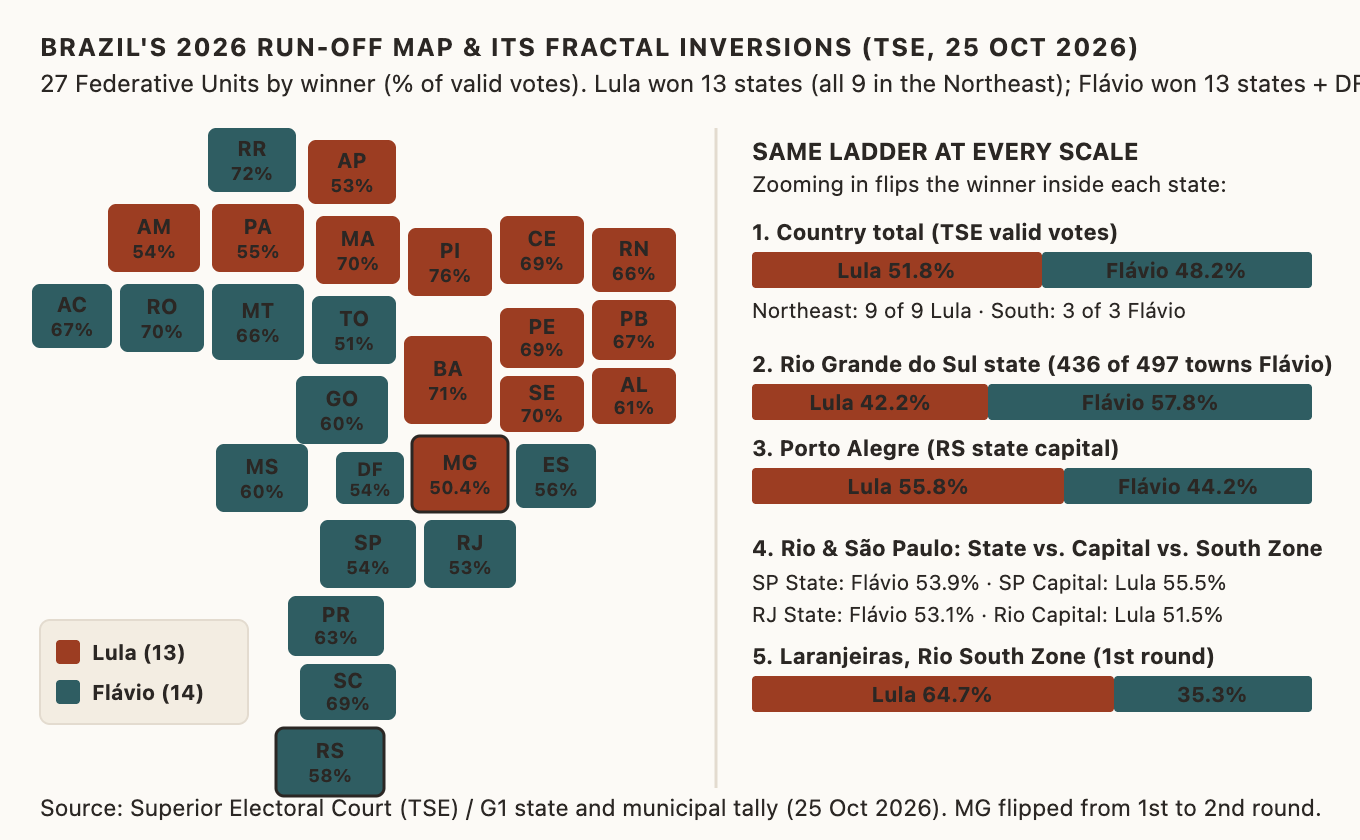
In October 2026, Brazil went to the polls twice in three weeks and came out of the ballot boxes split almost down the middle both times. In the first round on 4 October, Senator Flávio Bolsonaro led President Luiz Inácio Lula da Silva by 47.03% of valid votes to 45.16% (O Globo). In the run-off on 25 October, Lula reversed the first-round order for the first time in Brazilian presidential history, winning a fourth term with 51.79% of valid ballots (64.26 million votes) against 48.21% (59.83 million) for Flávio Bolsonaro, while the country’s twenty-six states and federal district split thirteen to fourteen (G1; TSE). On both Monday mornings, I knew the numbers before I unlocked the phone. I unlocked it anyway.
The gesture is familiar to anyone with a smartphone. Scroll, stop, scroll again. What appeared on the screen was familiar too, and it had been written before the polls closed.
On one side, scorn for people who had “voted with their wallets”: the businessman painted as a predator, the farmer as a poisoner of rivers, the evangelical pastor as a con man fleecing the poor. On the other side, scorn for the “indoctrinating” schoolteacher, the scientist “on the state payroll”, the civil servant who is a “parasite”, the voter from the poorer Northeast who “doesn’t know how to vote”.
The words changed depending on the trench, and the roles of winner and loser swapped between the first Sunday of October and the last. The choreography was identical. Someone had to be lowered in public so that someone else could rise half a step.
It was a scoreboard. Not a debate, not even an argument. A running tally of who was up and who was down, refreshed every few seconds, with a little counter under every sentence showing whether the crowd approved.
When I first drafted that paragraph months ago, I wrote without thinking that lucidity had become “rare in the feed”. Rereading it, I stopped at the word “feed”. Whose feed? Mine. No feed is a window onto a country. Every feed is a mirror trained on our own clicks, on the half-second our eyes linger on one insult rather than another. If my screen served me contempt before breakfast, it was partly because I had stopped to watch.
So the first suspect in this story is me. I was educated by the passions I am about to describe, and I have stood on more than one side of them.
Being seen
A few weeks before the election, I had listened to the journalist Ezra Klein talking with the political scientist Francis Fukuyama about The End of History and the Last Man, the book Fukuyama published more than thirty years ago.
That book is usually remembered, mostly by people who haven’t read it, as a triumphant hymn to liberal democracy and the market. It never was. Its quiet worry was that physical safety and material comfort might not be enough to satisfy a human soul.
At one point Klein described the gesture of my thumb better than I could have. Social media, he said, is “a constant measuring of recognition. Are you seeing me? Are you liking me?”
Fukuyama reached back to Adam Smith and Plato to name what fuels that measuring. In The Theory of Moral Sentiments (1759), Smith asks what all the toil and bustle of this world is really for, once a worker’s wages already cover the needs of the body. The answer is not bread; it is to be noticed and regarded with sympathy, whereas the poor man feels placed “out of the sight of mankind”, walking through a crowd in the same obscurity as if shut up in his own hovel.
He exists in the dark.
In Book IV of the Republic, Plato gives that hunger its classical name. Alongside reason, which calculates, and appetite, which wants food and comfort, stands a third part of the soul reducible to neither: thymos. Thymos is the part of us that blushes when humiliated, bristles at an insult, and cannot let a slight pass. It demands that our worth be recognised by others.
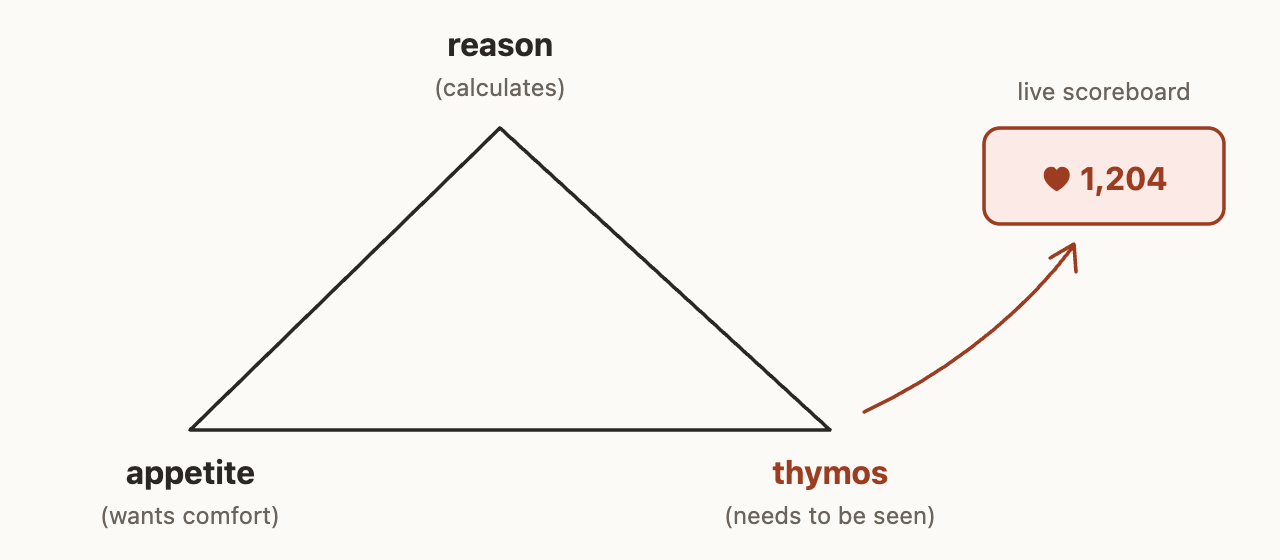
Fukuyama splits thymos in two, and the split is essential for everything that follows. Isothymia is the demand to be respected as an equal: not to be humiliated, not to be treated as less than a full adult. Megalothymia is the desire to be recognised as superior: to stand out, to look down. The first is the moral engine of every struggle for dignity. The second is the engine of every aristocracy, and of every snob.
Politics catches fire when the first is wounded at the bottom and the second finds a megaphone at the top.
People do have real, rational disagreements about tax rates, labour laws, deforestation and public budgets. Reason and material interest are not illusions. Wait to see what turns a policy disagreement into hatred, however, and you will find that it is almost never a calculation of utility. What makes people stop listening, what makes a citizen refuse a programme designed for his own benefit, what makes a Sunday family lunch go silent, is mostly thymos, not reason. It is the sting of being looked down on, and the intoxicating pleasure of looking down on someone else.
The feed did not invent this hunger. Plato knew it, Smith knew it. But the feed gave thymos something new: a number. As the writer Luke Burgis observed in an October 2026 Big Think conversation about his book The One and the Ninety-Nine (2026), social psychologists showed back in the early 1970s that if you give strangers a completely arbitrary label (telling them they over-estimated or under-estimated the number of dots flashed on a screen), within minutes they start distributing rewards to favour their own label, even at a cost to themselves, just to widen the gap between “us” and “them”. Today’s platforms run that minimal-group experiment on whole nations all day long, attaching a live score to every sentence.
Where does that hunger for rank learn its lines, long before we touch a screen? For me, the first step starts in a village.
The ladder
I was born in a farming village in the countryside of Casca, a small municipality in the north of Rio Grande do Sul, Brazil’s southernmost state.
My family carries the typical mark of that geography. My grandparents were settler-farmers, descendants of the Italian smallholders who cleared those hills at the end of the nineteenth century. My parents left the fields to open a small hotel and restaurant by the highway. My uncles split between the land, the metal workshop, the quarry and the shop.
In the 1980s and 1990s, local politics there was not a seminar on the destiny of the world proletariat. It was a parish rivalry, almost a family feud, between the conservative party that had inherited the military regime’s local apparatus and the moderate opposition. People voted for the cousin, the neighbour, the man who had lent a tractor when the harvest was late.
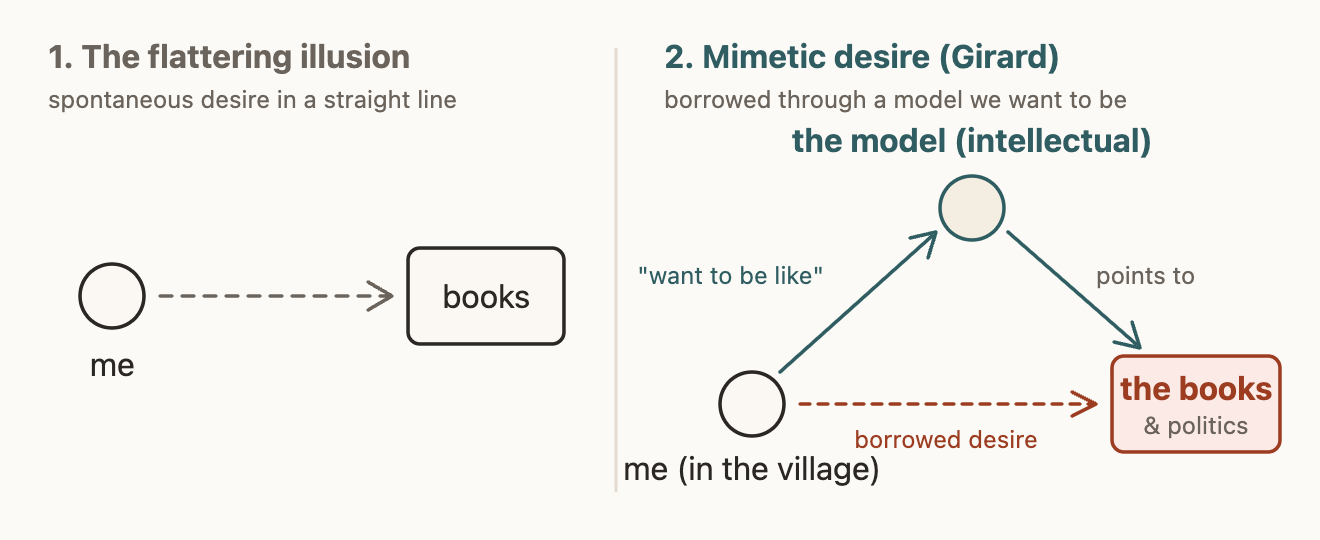
For a teenager who loved books, the horizon of the village sometimes felt too narrow. My move toward the left and toward the classics of philosophy was not only an intellectual awakening. Looking back, it was a textbook case of what the French thinker René Girard, in Deceit, Desire and the Novel (1961), called mimetic desire.
Girard takes apart the flattering modern illusion that our desires spring spontaneously from an autonomous core inside us. We don’t desire objects in a straight line, he argues. We borrow our desires from a model: someone we admire, whose way of being shows us what is worth wanting. Before I wanted socialism as an economic programme, I wanted to be like the intellectual: the scientist, the philosopher, the writer who put the whole world in question.
The books were the vehicle. The model was the destination.
Reality, however, has its own pedagogy.
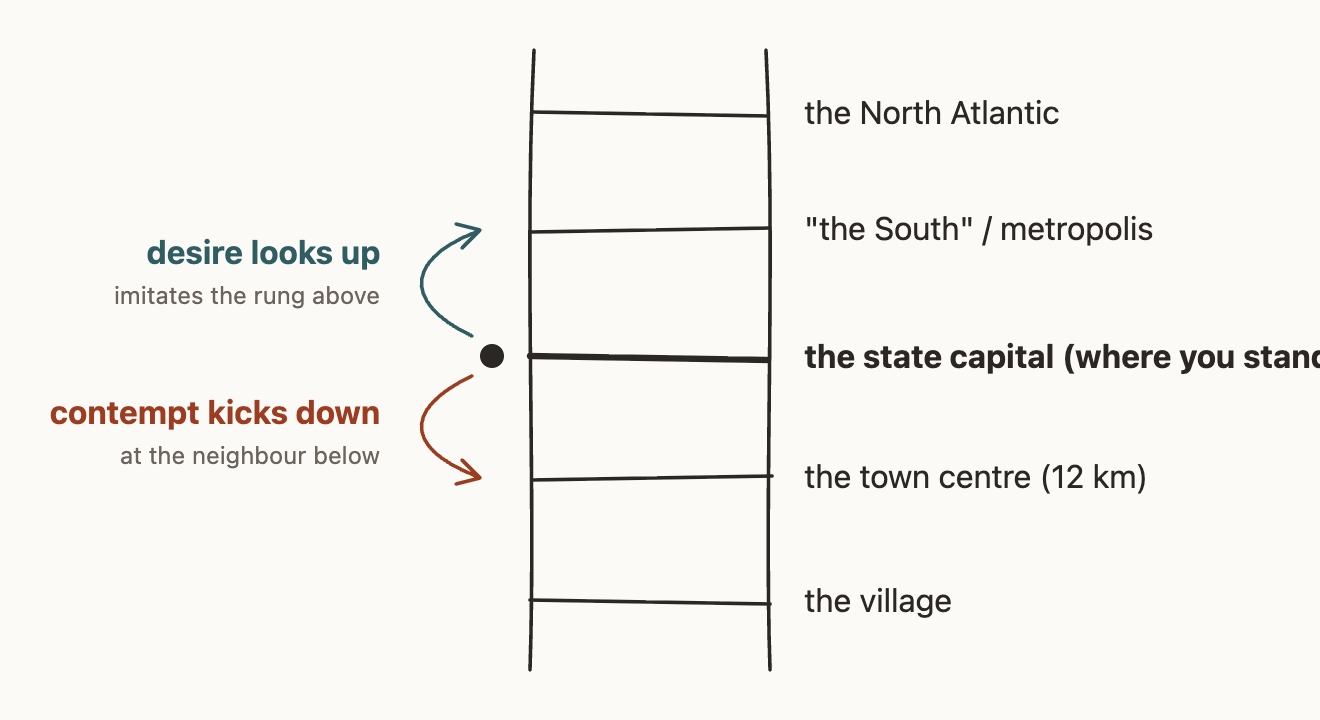
The first lesson came when I left the village for secondary school in the town centre, about twelve kilometres away. In the schoolyard, the town boys looked down on the settler-farmers’ kids from the countryside. The local word for us, colono, is in the history books a neutral term for the smallholder settlers of southern Brazil. In that schoolyard it was not agrarian sociology. Calling a classmate a colono meant he smelled of the cowshed, that his family was too rustic for that modest stretch of asphalt.
Twelve kilometres. Twenty minutes on a bus. That was the whole distance between being a person and being a joke.
A few years later I arrived in Porto Alegre, the state capital, to study philosophy at the federal university, and watched the exact same play on a bigger stage. Classmates raised in the capital, effortlessly convinced they embodied the moral and aesthetic vanguard of the state, spoke of people “from the countryside” with an irony that came close to disgust. The accent, the clothes, the Sunday Mass, the father’s pickup truck: all of it was material for a knowing smile.
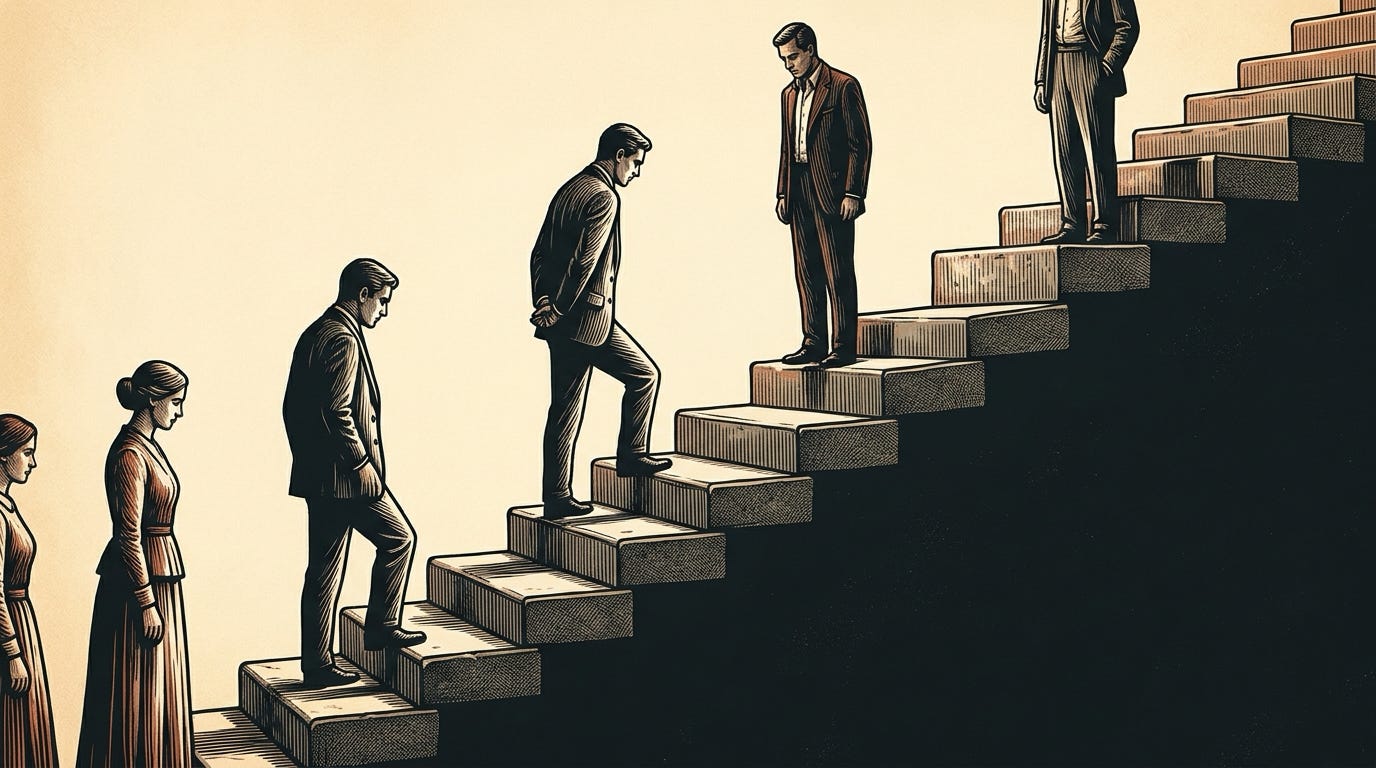
I had barely climbed one rung, and I was already learning the building’s unwritten rule. To breathe easily on your floor, you need someone backward on the floor just below.
Later, during a doctorate in England and research stays in the United States and Germany, I saw the comedy a third time, now performed with impeccable manners in the common rooms of great universities. The metropolis looks at the researcher from the global provinces (the Brazilian, the Latin American, anyone born outside the intellectual centres of the North Atlantic) as an articulate, curious, sometimes charming and irredeemably exotic specimen. Nobody was rude. Nobody needed to be.
Cultural arrogance is fractal.
Zoom in or zoom out and the geometry repeats unchanged: from the village to the town centre, from the town to the state capital, from the capital to Oxford and Berlin. At every scale, whoever has just climbed half a rung feels a quiet pressure to invent a barbarian on the rung below to certify their own arrival.
There are ladders this series does not climb. The ladder of skin colour in Brazil has rungs and violences that my biography as a white southerner does not allow me to describe from the inside, and pretending otherwise would betray the distinction between second-hand knowledge and lived weight that this series is built to defend.
Neighbours make the worst rivals
Why is our fiercest contempt aimed one rung down, rather than at the very bottom or the distant top? Girard gives the geometry.
Don Quixote does not want the barber’s brass basin he wears as a helmet for its own sake. He wants the chivalric glory of Amadís of Gaul, a paper knight from the romances who lives in another world. When the model is that far away, Girard speaks of external mediation. Distance rules out competition, so imitation remains open admiration. We can even become better by copying a model we will never have to fight for the same chair.
Everything changes when the model lives close enough to want the same things, on the same ground. Girard calls this internal mediation. Now the neighbour is also an obstacle, competing for the same standing, the same grant, the same moral authority in the room. Admiration curdles into rivalry.
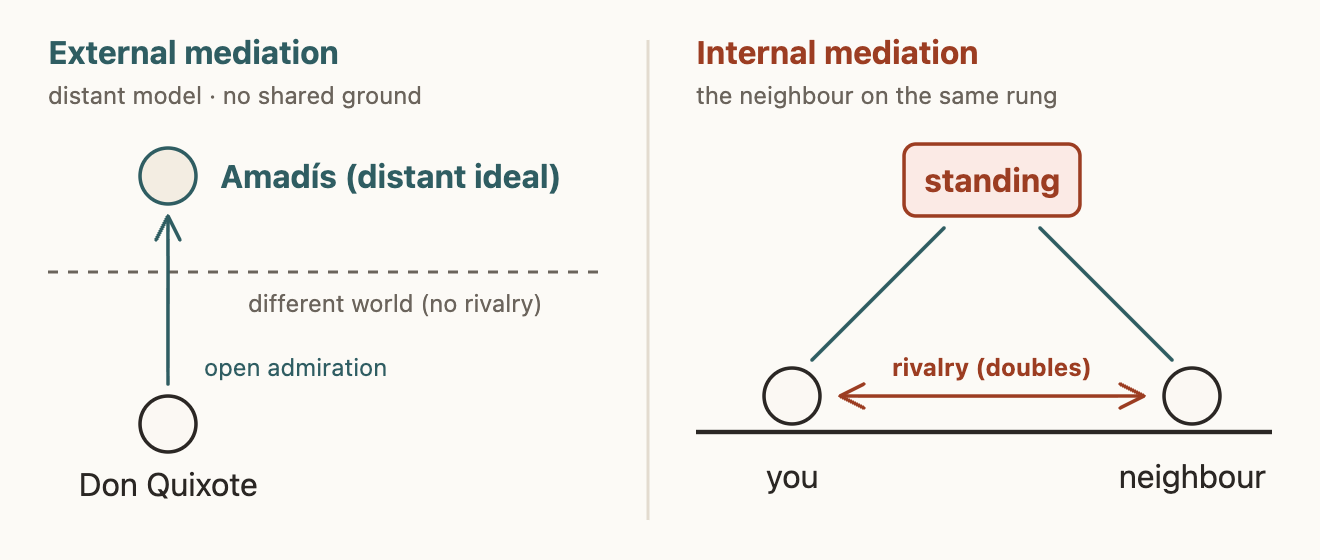
That horizontal rivalry explains why vertical contempt on the ladder always kicks one rung down. Those whose standing at the very top is unassailable rarely need to humiliate the bottom to know where they stand. It is the people who have just climbed a step, or who feel their step wobbling, who look down with vertigo. Because to an observer standing higher up the ladder, the town boy and the colono twelve kilometres away look virtually identical. We kick down hardest at the neighbour one rung below because he is the person we can most easily be mistaken for.
You can run the test privately. Think of whoever triggers your most immediate, visceral contempt in politics: not the abstract category you critique on paper, but the person whose voice or post makes your jaw tighten. It is rarely a tycoon on another continent. It is almost always someone close enough to share your table: the cousin who went to the same school and votes the other way, the colleague in the next office, the neighbour whose pickup truck is parked beside your hatchback.
When that boundary anxiety stretches across a whole country, it also fuels regional scapegoating. In the October 2026 run-off, just as in 2022, Lula won and expanded his margin across all nine states of the poorer Northeast, while Flávio Bolsonaro carried every state in the South, taking 57.84% of the vote across Rio Grande do Sul even as Lula won 55.84% in the state capital, Porto Alegre (G1; Sul21). Within minutes of the count, feeds in the south were again overflowing with sneers at Northeastern voters who “don’t know how to vote” or “traded their future for a handout”, while feeds in the capital mocked the interior. The boy who was a colono in the eyes of Porto Alegre, and the Porto Alegre student treated with polite condescension in Oxford, can both find someone half a rung lower on the national map to hand the humiliation down to.
And Girard draws one more consequence that unlocks the puzzle of our two political camps. Rivals who spend years fighting over the same scoreboard end up resembling each other. He calls them doubles. The harder each camp defines itself against the other, the more the two mirror each other’s moves. As Burgis puts it in The One and the Ninety-Nine: “When people try to stand out through rivalry, they usually end up more alike than different.” Keep that line in mind. It is the key to Brazilian politics.
I began this essay with my thumb on the glass, watching the scoreboard refresh before breakfast. We can now see what was happening on that screen.
Each sneer that scrolled past was a small, anxious transaction on the ladder. The voter celebrating the victory and the voter mourning the defeat were not, mostly, debating tax rates, labour codes or environmental enforcement. They were reassuring themselves that they were not the neighbour on the rung below. Neither camp was looking at the distant top. Each was kicking down at the adjacent step, the one it was most terrified of being mistaken for.
And I was doing it too. Every time my thumb lingered on an insult that confirmed how reckless the other side was, I felt a quiet warmth that had nothing to do with lucidity: the warmth of being on the right floor.
Yet a status ladder, even a fractal one, is only the architecture of desire. The harder question is how we justify that contempt to ourselves: how two camps that have become doubles convince themselves of their own moral purity, and how well-meaning elites alienate the very working people they claim to protect.
Next in the series · Part 2 of 4
The Refusal. Why affluent progressive enclaves vote left while capitalised family farmers, app couriers and evangelical working communities turn right. How ressentiment falsifies productive work and knowledge in mirror image, and why adult citizens reject paternalism as a form of humiliation.
Followed by Part 3 · The Raised Hand (the mechanics of open-vote assemblies, the permanent feed, and the perception gap) and Part 4 · What Weighs (Stanley Cavell, acknowledgment, realism, and the forge).
References · Part 1
Klein, E. & Fukuyama, F. “Why I Can’t Stop Thinking About ‘The End of History’.” The Ezra Klein Show, 11 Sept 2026 (iHeart / YouTube).
Plato, Republic, Book IV (439e-441c).
Fukuyama, F. The End of History and the Last Man (1992); Identity: The Demand for Dignity and the Politics of Resentment (2018).
Smith, A. The Theory of Moral Sentiments (1759), Part I, Sec. III, Ch. II.
Burgis, L. “Finding and protecting selfhood in the age of social contagion.” Big Think, 23 Oct 2026 (video). The One and the Ninety-Nine: Forging Identity in the Age of Social Contagion (St. Martin’s Press, 2026; book page), quoted in S. G. Adubato, “How to Belong Without Losing Oneself”, First Things, 4 June 2026, and M. Halbrook, “The One Who Stays”, 5 Aug 2026.
Tajfel, H. “Experiments in Intergroup Discrimination.” Scientific American 223(5), 1970, pp. 96-102 (doi).
Girard, R. Deceit, Desire and the Novel (1961; Eng. tr. 1965).
Electoral sources: First round 2026 (O Globo); Run-off 2026 (TSE; G1; G1 state maps; Sul21).