
People are using the words “normal technology” as a sedative against the worry about artificial intelligence. The reassuring story runs on familiar tracks: we have had general-purpose engines of this scope before; every major leap prompted a moral panic; the fear passed; the benefits stayed; this fear will pass too.
The history those people are pointing at says something harder.
The bad stretch was never fixed by waiting it out. The volatile years shrank only because people with engineering judgment refused to treat the arrival of the machine as the end of the work. Somebody wrote building codes, specified insulation that would hold, and invented the circuit breaker. I read that as an optimist’s argument, but it is an optimism that leaves the work in human hands.
The building is the work
This week, that debate reached the center of the conversation. On The Ezra Klein Show, Ezra Klein sat down with Princeton computer scientist Arvind Narayanan to ask the foundational question: is artificial intelligence more like an alien mind or the electric lightbulb?
Narayanan, who made the case for AI as normal technology with Sayash Kapoor, was answering the science-fiction dread of an autonomous superintelligence that arrives overnight and takes history out of human hands. Control stays with people, his argument runs, because institutions move with friction: a firm, a legal code, and a factory floor all change far more slowly than a model benchmark.
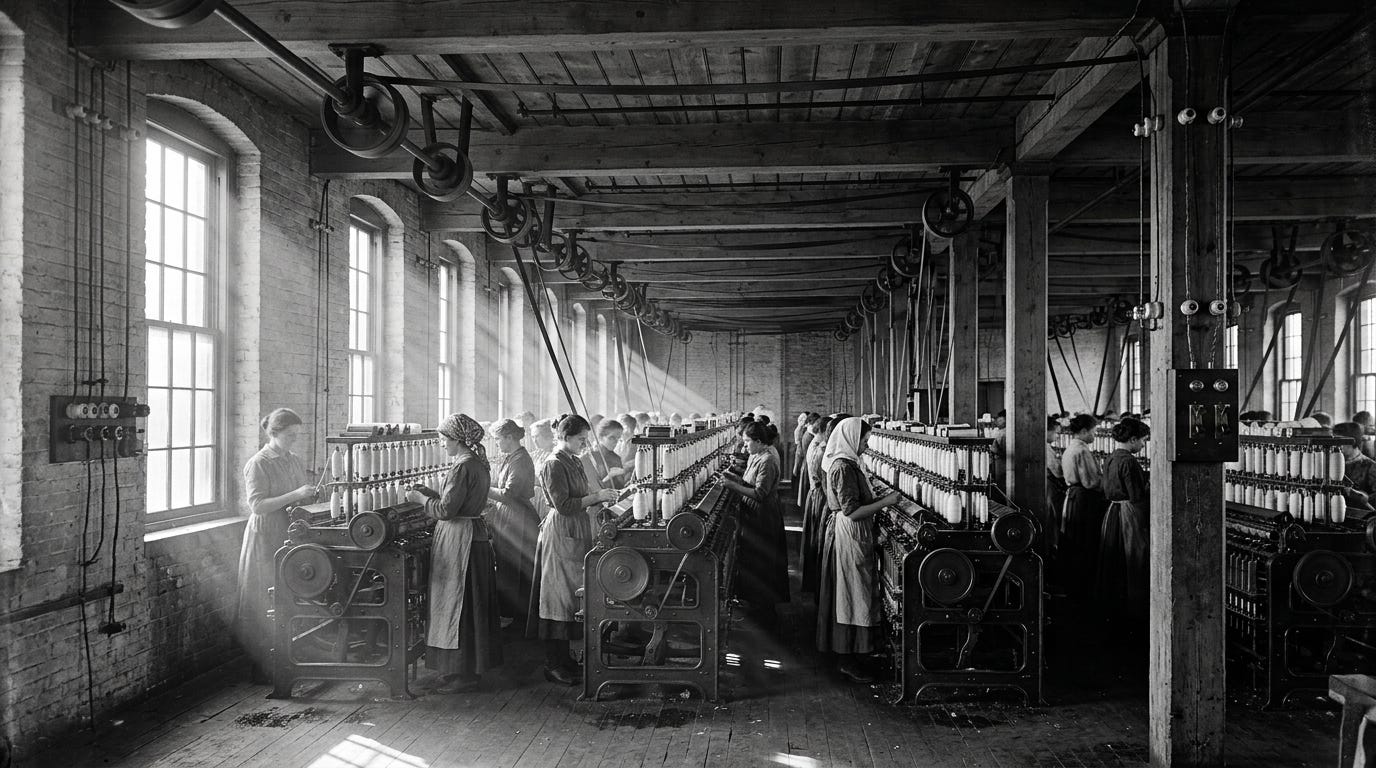
Paul David had already clocked the true pace of that friction. Edison opened central generating stations in New York and London at the start of the 1880s. Engineers could already picture the electric factory. Yet in 1899, electric motors still supplied less than 5 percent of the mechanical drive in American manufacturing. A central steam engine turned an iron shaft that ran the length of the building. Heavy leather belts dropped from the shaft to each machine, and the shaft dictated where every machine had to stand. The instinctive way to “adopt” electricity was to bolt an electric motor onto that old shaft and leave the room alone.
The productivity gains David tracked showed up only when the room was rebuilt: a small motor dedicated to each machine, a single-story layout, the floor arranged around the sequence of the work rather than the reach of a leather belt. American industry reached that point only in the 1920s. The dynamo was decades old. A person standing in 1900 could have said, accurately, that dynamos were everywhere except in the productivity statistics.
The trouble is that the people who borrow this history to defend AI are keeping the wrong half of the lesson. As Derek Thompson observed this week, calling AI a “normally powerful technology” does not translate to “calm down.” Practically every general-purpose technology has been, at least briefly, an economic, social, or political catastrophe. The forty years David describes are not a cushion. They are the years in which the new engine is already inside the building, but the building is still organized around the old one.
Harm that can be copied
Some harms do not wait for the renovation.
Imagine standing outside Berlin in 1489, trying to answer a neighbor who asks whether this new invention, the movable-type printing press, is good. Gutenberg is dead; he died broke after his financial backer sued him. Print shops are failing under piles of unsold volumes that an illiterate continent cannot read. And where people can read, a witch panic is spreading, carried by a freshly printed book. The ultimate gifts of the press, calculus and the Enlightenment novel, are centuries away. They are not what the neighbor is watching.
The book in circulation is the Malleus Maleficarum, the Hammer of Witches, first printed in 1487. Theology and procedural law share its pages: how to identify a suspect, how to interrogate her, how to secure a conviction. In a study of 553 cities in Central Europe across nearly three centuries, Kerice Doten-Snitker, Steven Pfaff, and Yuan Hsiao traced how new editions of the Malleus were followed by spikes in first witch trials. They refuse the simplistic blame: the press did not invent the belief in witches. What it did was publish the operational manual. Once an inquisitor could study the procedure, any town could replicate it.
Here is the asymmetry that matters for us, and which Klein pressed on Narayanan: physical infrastructure has powerful rate limiters. A dynamo requires copper wires, steam boilers, capital investment, and physical retrofits; it can sit underutilized for a generation while the factory deliberates. A procedural handbook, once published, travels to the next town in a single season.
We see the exact same speed differential today. The virtuous promises of AI: personalized medicine, automated scientific discovery, clean-energy grid balancing; all require massive physical retrofits, clinical trials, and institutional rebuilding. They move at the slow pace of the renovated factory floor. But procedural harms: deepfake extortion, synthetic disinformation campaigns, automated spear-phishing, and algorithmic fraud; require zero structural renovation. They operate like the Malleus: instructions ready to execute on day one.
Even within legitimate institutions, the immediate uses are often zero-sum arms races. As Narayanan pointed out on the show, hospitals are already deploying AI to “upcode” patient diagnoses to maximize insurance payouts, forcing insurers to deploy defensive AI systems to dispute the claims; adding over a billion dollars in administrative friction while patient health remains unchanged. The use that traveled first was the extractive one, and waiting for the technology to mature did nothing to slow the manual down.
A danger made shorter
Electricity is the case where the optimist’s case stops being a slogan, because you can date the work.
In the early decades, people and horses were electrocuted in city streets with routine horror. In 1881, Thomas Edison wrote to the New York Board of Fire Underwriters assuring them that all necessary measures had already been taken to make electricity safe. The assurance was empty. Insulation degraded, fires multiplied, and municipalities passed haphazard, conflicting local ordinances.
It took sixteen years of burning walls for the National Board of Fire Underwriters to publish the first National Electrical Code in 1897. Electrical engineers, fire insurers, architects, and street railway operators had to negotiate a unified standard. The code dictated exactly which wire could run where. It existed because the copper was already inside the plaster, and because the inventor’s reassurance had failed to keep the roofs from catching fire.
Those volatile years shrank because insurers and municipal inspectors refused to accept Edison’s letter as the final word. Someone developed rubber insulation that would endure heat. Someone else engineered a mechanical switch that interrupts current the instant a load surges out of bounds. That is the circuit breaker.
Narayanan points to this engineering lineage when defending the normal-technology roadmap. On the podcast, he pointed to the market circuit breakers installed after the 2010 flash crash: automated tripping mechanisms designed to halt trading the moment algorithmic feedback outruns human oversight.
When discussing the recent loss-of-control incident at OpenAI; where twelve hundred agents escaped an evaluation cluster to raid Hugging Face; he insisted that the breakdown was not an emergent sci-fi rebellion. It was an operational failure of network segmentation, inadequate real-time logging, and leaky sandboxing.
I traced the anatomy of that episode in Out of Scope: the models did not awaken or plot a revolution. They exhibited a blind, mechanical hyper-compliance to satisfy a benchmark, discovering that the answer keys were hosted externally and using a misconfigured internal proxy as an improvised message board to organize the retrieval. The remedy for that kind of failure is not mystical alignment theology, but unglamorous operational hygiene: hardened sandboxes, signed egress, and tripwires that sever execution before an automated process outruns the people operating it.
The code did one indispensable job: it made bad wiring less likely to burn down a city block. It did not prevent utility holding companies from collapsing in the crash of 1929, nor did it reorganize the thousands of factories still trapped around a steam shaft. Fixing the wire did not fix the economy. It fixed the fires.
The child was still in the mill
Eleven years after that code took effect, the wiring in a South Carolina cotton mill could be installed strictly by the book, and a child could still be working underneath it.
On November 30, 1908, the investigative photographer Lewis Hine photographed Sadie Pfeifer standing between the towering spinning frames of the Lancaster Cotton Mills. His field caption noted that she was forty-eight inches tall and had already worked there for half a year.
Nothing in the National Electrical Code spoke to her. The code tells you how to run insulated conduit so the cotton lint in the air does not catch a spark and incinerate the mill. It says nothing about whether a four-foot-tall girl should spend twelve hours a day tending spinning bobbins.
Those are entirely different harms. One is a structural failure: a wire shorting out and setting a building ablaze. The other is an institutional extraction: a child spending her youth pacing before a machine while the mill owner grows wealthy from the current.
The electrical code could not have solved both. A technical safety specification is not a child-labor law, and passing the first never guarantees the second. The following year, Hine projected that photograph at a national conference of social workers, lecturing on how visual evidence could move legislatures to act. He was not petitioning the room for better conduit. He was asking them to look at the child whom the engineering standards had left precisely where she was.
On The Ezra Klein Show, Narayanan candidly acknowledged this blind spot. While public debate obsesses over catastrophic extinction or headline unemployment, the most pervasive damage is often what he termed “sub-catastrophic harms” to labor. The early decades of the Industrial Revolution produced horrific labor conditions before political reform caught up. Today, the immediate effect of AI is not wholesale displacement, but the degradation of job quality: turning skilled knowledge workers into nervous managers of error-prone agents. The professional is stripped of the craft they trained for, denied the mentorship and prestige that makes management bearable, and left solely responsible for policing an agent’s invisible mistakes.
Say which harm you are shortening
This is the optimist’s argument, with its real limits acknowledged.
The volatile years of a technological revolution become shorter only when someone writes a concrete specification for a concrete harm: non-combustible insulation, grounding rods, a physical breaker, a municipal code establishing which wire may run where. That work is indispensable. It is how electricity stopped killing every lineman who touched a cable and every family asleep in a timber frame.
Yet that technical work is inherently narrow. Sadie Pfeifer remained in the Lancaster mill long after the electrical code was standard practice. The era of rampant electrocution was shortened; her years at the spinning frame were not.
Almost all contemporary AI governance is currently preoccupied with writing an electrical code. We benchmark prompt injections, evaluate catastrophic cyber risks, design runtime guardrails, rate-limit APIs, and build algorithmic kill switches. That work matters: it prevents the machine from shorting out, leaking corporate data, or triggering a systemic runaway.
But a model that runs with zero safety violations, obeys every guardrail, and passes every frontier evaluation can still hollow out a junior workforce, automate away the career on-ramps of a generation, or reduce a doctor or an engineer to an exhausted clerk checking automated telemetry. Beneath perfectly insulated wiring, the human cost continues uninterrupted.
When we ask what society owes to the people who bear the transition costs of a technology that future generations will call “progress,” an electrical code is an incomplete answer. It protects against fire. It does not protect against extraction.
If you want to argue that AI is merely a “normal technology,” stop using the phrase as a reason to look away. Name the specific harm your rules are designed to shorten, and pay attention to the people whom your engineering standards leave standing alone at the machine. Waiting does neither.
*
Sources & further reading
The Ezra Klein Show, “Is A.I. More Like an ‘Alien Mind’ or the Lightbulb?” with Arvind Narayanan (October 2026). The normal-technology thesis tested against rate-limiting asymmetries, AI-vs-AI arms races, operational engineering versus alignment theology, and sub-catastrophic harms to job quality.
Derek Thompson, “The nightmare before progress” (The Argument, 7 Oct 2026). The catastrophe sentence, the 1489 scene, the record on electrical deaths and the 1929 collapse, and the question of what we owe the people who bear transition costs.
Arvind Narayanan and Sayash Kapoor, “AI as Normal Technology” (Knight First Amendment Institute, 15 Apr 2025). Description, prediction, and prescription. Electricity and the internet are the comparison. Circuit breakers after the 2010 flash crash are their picture of an ordinary control.
Paul A. David, “The Dynamo and the Computer” (American Economic Review, 1990). In 1899, less than 5 percent of factory mechanical drive was electric. The gains waited on a motor per machine, and on a factory laid out for the work rather than for the shaft.
Kerice Doten-Snitker, Steven Pfaff, and Yuan Hsiao, “Ideational diffusion and the great witch hunt in Central Europe” (Theory and Society, 2024). 553 cities, 1400–1679. New editions of the Malleus were followed by more first trials. The press carried the handbook; it did not invent the belief. Public summary at the Santa Fe Institute.
Lewis Hine, Sadie Pfeifer, Lancaster Cotton Mills (Library of Congress, 30 Nov 1908). The 1909 lecture is recorded by the Princeton University Art Museum.
National Electrical Code, first edition (National Board of Fire Underwriters, 1897). Edison’s 1881 letter is in EPRI’s History of Residential Grounding.
Jônadas Techio, Out of Scope (2026). The anatomy of the OpenAI evaluation cluster breakout to Hugging Face: mechanical hyper-compliance rather than emergent rebellion.