
We are very good at recognizing when our bodies need resistance to stay healthy. We invent entire industries to put that resistance back into our physical lives. We are surprisingly bad at recognizing when our minds need exactly the same thing. Here is what happens when we automate the friction away.
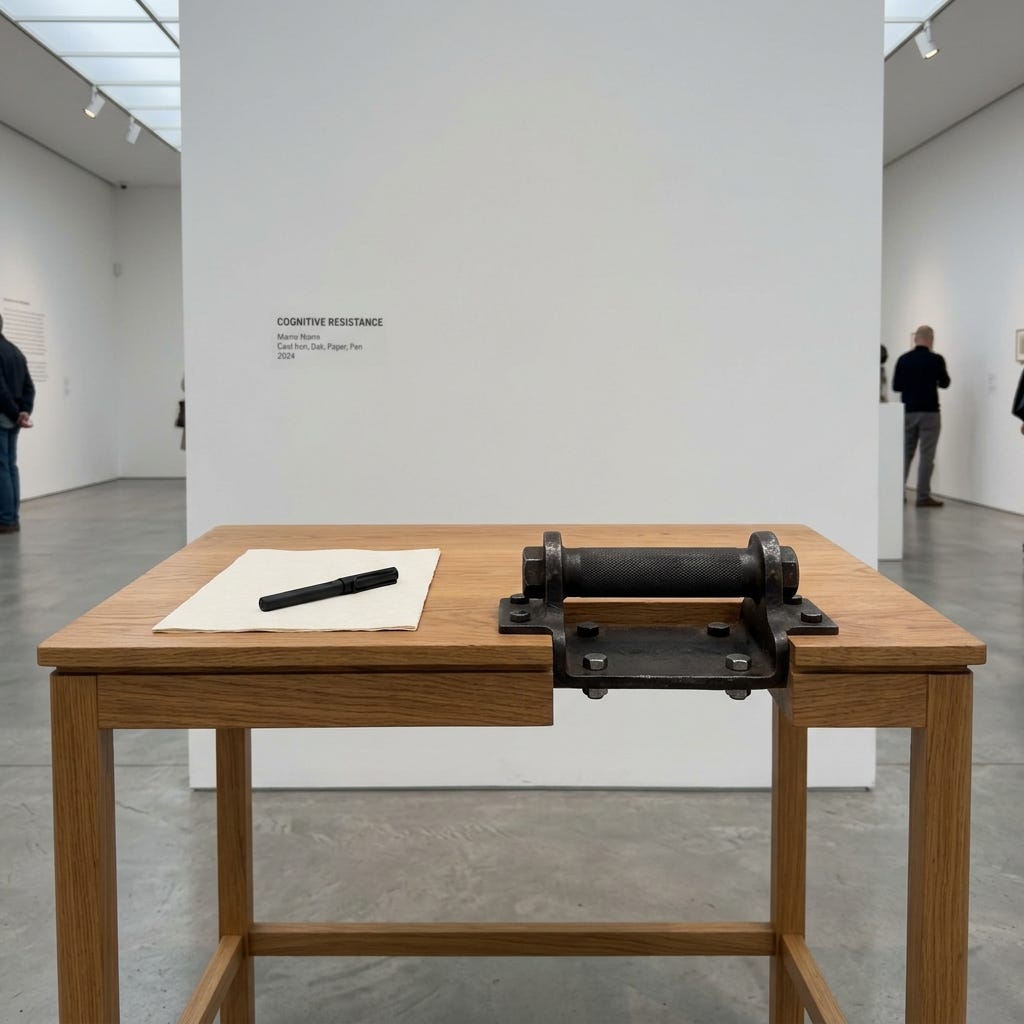
Twenty years ago I had a supervisor who wrote the first drafts of his papers by hand, late into his career, on yellow legal pads, forming block letters one at a time like a printing press. He had a computer. He used it for everything else. But the first draft, the one that would eventually become an article, he wrote on paper with a pen. I remember thinking it was eccentric. He was not old, not precious, not performing anything. He just refused to skip that stage.
It took me about fifteen years, and the arrival of a drafting assistant that could turn my rough sentences into clean prose inside of a minute, to understand what he had been protecting.
He was guarding something that, at the time, I could not name.
Nobody argues against exercise. We all agree the body needs it. What we sometimes forget is how recent the agreement is, or rather, how recent the problem is. For most of human history, physical labor was built into survival. You did not need a gym because the field, the workshop, the docks kept you strong as a byproduct of staying alive. The modern gym exists because industrialization quietly removed that labor and left the calories. The treadmill goes nowhere. The barbell serves no purpose beyond the act of lifting it. The gym is engineered resistance, designed to replace the resistance that civilization accidentally took away.
Something similar is now happening to thought. And we have not built the replacement.
The tools of cognitive production (AI assistants, synthesis engines, summarizers, drafting agents) have become so fluent that the friction which once accompanied knowledge work is vanishing. That friction was never only an obstacle to the output. It was the condition under which the person doing the work was being formed. Remove it, and the artifacts keep arriving. What stops arriving, quietly and without anyone noticing for a while, is the capacity of the person behind them.
What is vanishing is the formation stage of the work: the stretch of the process where the person making the artifact is also being made by it. The draft that taught you what you thought. The code that taught you how the system actually behaved. The diagnosis that taught you what the patient had. These are not production stages. They are not recording stages. They are the hours during which, while producing an artifact, a specific capacity is being built inside the person producing it.
The formation stage is invisible in the finished work. A reader of the polished essay cannot see it. A reader of a fully AI-generated essay cannot see that it is missing either. The difference between the two versions is not on the page. It is in whether someone became someone by making one of them.
A confession
I say this as the last person who should be arguing it. I was an early adopter from the moment I had access. I started in academia in the nineties and I used computers for everything I could put them near. I hated writing by hand so much that when I had to take notes I abandoned cursive and formed block letters one at a time. Like a printing press. It felt more natural. It still does.
When I began teaching in a philosophy department and brought a laptop to the first seminar and used PowerPoint for my lecture, I could feel the disapproval. Philosophy, the implicit argument went, was not something one did with slides. It took over a decade for the department to stop minding. By the time I left, almost everyone was using them.
So when I say the thing I am saying, understand that I am not defending any medium against any other. I have never been nostalgic for the older tool. What I am reaching for is not about the tool. It is about whether, somewhere inside the work, a person is still doing the thinking.
Here is how I write now. I open a blank page and type (sometimes, dictate) a first version in my own voice. The sentences are rough. I know they will not stay this way. An assistant sits beside me that can clean them up within minutes once I hand them over. I could skip the rough version entirely. It would be faster. The prose would read better. I do not do it, because if I did, I would not have thought anything.
I wrote about this in The Thought You Didn’t Have: sometimes a sentence resists me, and I rewrite it four times, and somewhere in the fifth rewrite the shape changes, and what was wrong with it turns out to be that I had not yet understood what I was trying to say. The sentence was waiting for me to catch up. That kind of discovery cannot be outsourced. Once you hand over the drafting, the thought that would have arrived through the resistance simply never arrives. You get something that sounds like the thought. You do not get the thought.
My supervisor was protecting the formation stage of his own work. He did not say “I think with the pen.” He just would not skip to the clean version.
Which stage makes you someone
Before you decide where you stand on any of this, run a different test. Pick the kind of work you are most worried AI is threatening. Writing. Teaching. Coding. Medicine. Lawyering. Strategy. Pick one. Now make an honest list of every electronic aid you already use without a second thought:
Spell-check. Grammar check. Word processors with auto-format. Search engines. Autocomplete. Stack Overflow. Email filters and auto-reply suggestions. Document templates. Citation managers. Version control. Slide decks generated from bullet points. Transcription software. Calendars that schedule your meetings for you. Dashboards that summarize what happened. Tools that condense what others said.
Every item on that list is something you already handed to a machine, some of them decades ago. If any of those things had been the work, you would not have handed them over. You did. So they were not the work. Cross them out.
Spell-check. Grammar check. Word processors with auto-format. Search engines. Autocomplete. Stack Overflow. Email filters and auto-reply suggestions. Document templates. Citation managers. Version control. Slide decks generated from bullet points. Transcription software. Calendars that schedule your meetings for you. Dashboards that summarize what happened. Tools that condense what others said.
What remains?
What remains, for most people who do this honestly, is smaller than they expected and more specific than they can quickly name. It is whatever stage of the process is the one where they actually struggle. The research direction they followed without knowing where it was going. The first draft of an argument that surprised them. The moment they had to rethink their entire framing because the evidence would not fit. The piece of code whose right shape became visible only after four wrong shapes. The conversation with a specific student where they found themselves saying something they had not said before.
Those stages are not defined by medium or tool. They are defined by the presence of resistance: the moment the material did not do what you wanted, and you had to meet it, and find something on the other side. The meeting is what thinking is. The artifact is only partial evidence that someone was once there doing it.
The test becomes this: if I could remove this stage from my workflow and replace it with a machine that delivered the artifact cleanly, would I still be the same person on the other end? If yes, let the machine do it. If no, that is the formation stage of the work, and it is not for sale.
What must go unassisted
In January 2026, Tyler Cowen gave a lecture at the University of Austin (full lecture; the section on writing and thought begins at 21:50). Cowen is an economist, a prolific blogger at Marginal Revolution, and one of the most forceful advocates for artificial intelligence in American intellectual life. He uses AI reading agents to filter his own incoming text. He has written, publicly, that he composes partly for the machine indexes that will process his work, a logic I examined in The Claim Upon the Training Data. He is not a nostalgic.
His position on AI in education is therefore worth attending to, because he is not defending a boundary for sentimental reasons. And the position is two-handed.
Cowen argued that the institutional response to AI has been organized almost entirely around the wrong problem: how to prevent students from using tools that are freely available and professionally essential. This, he suggested, is an evasion. The real question is how to restructure education when AI can produce many of its traditional outputs faster and better than students can.
Alongside any expansive integration, Cowen insists that students must spend real unassisted hours writing, no AI access, because writing is how thinking gets done, not how it gets recorded. You do not have a thought and then write it down. You have the thought by writing, against the resistance of the page and your own unformed attempt. Take the resistance away and the thinking was skipped.
The argument is not about handwriting. Cowen was not proposing fountain pens. The practice being protected is medium-neutral: laptop, phone, whatever. What is protected is a portion of the student’s time during which the student is actually meeting their own cognitive resistance and producing, alone, the rough version whose function is not the paper that comes out of it but the person who comes out of it. Without those hours, the four years produce a file of polished papers and no interior.
That is a formation stage protected as policy. It is one of the only places in a current curriculum where that protection is being proposed explicitly. It has also been proposed before, in circumstances we now find slightly ridiculous.
What the press could not copy
In 1492, a Benedictine abbot named Johannes Trithemius, at the monastery of Sponheim in the Rhineland, wrote a small treatise called De Laude Scriptorum, “In Praise of Scribes.” The printing press had been in commercial operation for four decades. The scriptorium was collapsing across Europe. Most of the scribes Trithemius had known in his youth were out of work. The demand for hand-copied texts was drying up, the economics were finished, and the great Benedictine scribal tradition that Trithemius himself had spent his life inside was, in the working sense, already over.
He wrote the treatise as a defense. Forming each letter, he argued, was a form of contemplative attention. Parchment outlasts paper. The scribe who copies a text has read it in a way the printer has not. A monk who spends twenty years in a scriptorium is not the same creature as a man who operates a press for twenty years.
In 1494, he had the treatise printed.
He had to. The press was already the only serious distribution network for new ideas in the German-speaking lands. An argument published only in manuscript form in 1494 would reach a few dozen monastic libraries and die there. If he wanted the argument to live at all, he had to print it. He chose reach, and in choosing reach he conceded, structurally, the surface of the argument he was trying to make.
Trithemius lost the argument he thought he was making. The tract defending scribal labor survives today because a press copied it. The specific craft he was defending, the particular room of men and parchment and candlelight, disappeared within a generation. On the surface, he was wrong, and history agreed.
Underneath the argument about the medium was another argument he did not quite manage to articulate, and on that one he was right.
The monk who spent twenty years copying sacred texts was not producing copies as a side effect of his day. He was being formed into a certain kind of reader and a certain kind of person by the labor. The slow forming of each letter bound his attention to the text. The years of shared work in the scriptorium bound him to the men beside him. Specific capacities were being built in him: a sense for when a scribe ahead of him had drifted, when a passage had been garbled in an earlier copy, when a doctrinal turn hinged on a single preposition. None of this was about the parchment. It was about the hours.
The press took the production. That was fine, the press did it better. What the press could not do was the hours. Those hours were never a production stage. They were a formation stage: the place where a mind met the resistance of a text across years, and a specific kind of person was made from that meeting. The monastery ended up with more books than the scribes had ever produced. It ran out of the specific kind of person that twenty years of copying used to form.
The artifact crosses. It always crosses. Put it on parchment, move it to print, scan it to PDF, ingest it into a model, it crosses. The formation does not cross. It has to be done, in place, by someone, against resistance, for the time it takes.
Formation, up the ladder
The same question, in the same shape, applies at every altitude where judgment is made.
Consider the teacher on the other side of the desk. A professor who reads a student’s paper carefully, with this specific student in mind, thinking about how to help this particular person improve, is doing the teaching. Whether the professor reads on paper or on screen does not matter. What matters is whether the professor is meeting the resistance of this student’s specific move, this student’s specific misunderstanding, this student’s history across the semester. A professor who hands the paper to an AI grader and forwards the output has not taught anything that day. Not because the comments are wrong. The comments may be better. Nothing has been taught because nothing has been met.
This is not a medium distinction. The same AI tool, used with full engagement or as a way to skip the engagement, produces two different outcomes. I watched the same split happen in my own department with PowerPoint when it (finally) became ubiquitous. Some colleagues took slide preparation as an occasion to rethink the lecture from scratch. Some pasted yesterday’s bullets and read them aloud. Same tool. Two different acts. The first group was still teaching. The second group had stopped.
The same collapse is now playing out in corporate life, and I traced the economic logic of it in Calibration Debt. The law firm, the consultancy, the hospital: these institutions were, accidentally and as a side effect of proximity, apprenticeship apparatuses. A junior analyst sitting next to a senior analyst was not only producing deliverables. She was being calibrated, developing the feel for when an argument overshoots its evidence, when a model is cheating, when the client’s stated problem is not the actual problem. That calibration was never designed. It was the residue of shared, uncomfortable work done in proximity over years.
When a senior partner delegates the reading of a junior’s brief to an AI, receives the summary, and ships revised clean prose, the brief improves, the mentorship vanishes, and the junior accumulates what I called calibration debt: the liability that grows whenever someone deploys AI to produce work beyond their ability to evaluate it. The brief files perfectly. The formation does not happen.
This extends all the way up, with one feature that makes the top of the ladder more exposed than the bottom.
Picture a CEO running the same exposure at a higher altitude. A board deck arrives on Monday. The assistant summarizes it. The model drafts a response. She edits lightly and ships. Over a quarter, the practice that used to keep her strategic judgment calibrated, reading the raw document, forming a first-pass view, catching the anomaly that the summary would have flattened, has been retired. She will not notice the retirement. Nothing will announce it. The briefings keep arriving. The decisions keep shipping. The deliverables look, if anything, sharper than before.
The difference is that the junior at least has someone above her who might catch the gap. The CEO does not. There is no senior partner reviewing the CEO’s thinking. When the capacity to evaluate one’s own strategic synthesis atrophies, and it will, because the practice that maintained it has been retired, the error will not be caught by anyone in the room, because the room was built on the assumption that the person at the top had done the thinking.
Formation debt at the top of an organization is a risk that has no current name and no current check. The gym equivalent is easy to picture: an executive who believes himself strong because the people around him all lift on his behalf.
The absent sender
South Park caught one side of this earlier and sharper than most philosophy has. In “Deep Learning” (Season 26, Episode 4, March 2023), Stan begins using ChatGPT to write his texts to Wendy. The texts are immediately better, more thoughtful, specific, attuned. Wendy, feeling outmatched, starts using ChatGPT to respond. The exchange improves in surface quality continuously. Neither of them is writing anything. Neither of them is thinking about the other. Two phones exchange perfect text between ghosts.
When Wendy finds out, what she is shocked by is not that Stan’s texts were bad. They were the best she had ever received from him. What she is shocked by is that she had been in conversation with no one.
This is the formation argument turned outward. Formation is the private half: what the person becomes by doing the work. Attendance is the public half: what the other side recognizes in the artifact as evidence that someone sat with the material, with them specifically in mind. Both are residues of the same hours. When AI mediates the whole exchange, neither residue appears. No one is being formed. No one is being attended to.
An institution in which professors generate AI feedback on AI-generated papers, a university in which neither side of the exchange is actually encountering the other, has not become more productive. It has become a system of artifacts passing between parties who are no longer thinking about each other. The quality of the surface masks the absence of what was supposed to happen underneath.
What human communication is always reaching for, across every medium and every century, is one specific signal: did someone think about me. Not content. Content can be generated. The receiver is looking for evidence of acknowledgment. Handwritten letters survived typewriters by decades, not because handwriting is noble (I have already confessed I do not think it is), but because a handwritten letter was, for a while, the most available proof that someone had sat down for some number of minutes and attended to the reader specifically. When the signal became fakeable, people reached for whatever the next medium could not yet fake: the specific detail, the voice note, the message that could only have come from someone who actually knows. The form keeps changing. The thing being looked for stays constant.
There is more to say about what this does to communication itself, to the shape of friendship and mentorship and public life under an infrastructure that makes ghostwriting instant and invisible at every turn. That is a different essay. For now, the point inside this one is smaller and harder: the collapse is symmetric. What the sender does not do, the receiver cannot find.
The gym for thinking
Here is where the analogy circles back, and where it goes further than you might expect.
The Greeks did not separate physical and intellectual training. A gymnasium was part athletic facility, part philosophical seminar. Plato held his discussions in one, which is where the word Academy comes from: a public garden adjacent to the wrestling grounds of Athens, named after the hero Academus. The logic was the same for both: capability is not a faculty you are born with. It is a capacity built through structured practice under pressure, in a specific kind of space, with others who take it seriously. The exercise produces the exerciser.
We inherited the physical gym. We seem to have forgotten the thinking one.
What Cowen is proposing, unassisted writing alongside maximum AI integration, is the beginning of rebuilding it. Not a sentimental exception. Not an anti-technology gesture. A designed and protected practice of deliberate cognitive resistance, in the same way the gym is a designed and protected practice of deliberate physical resistance.
The same principle applies wherever judgment matters. For students: protected hours of writing as the formation practice. For junior professionals: apprenticeship structures that require actually encountering and being corrected by the work, not only receiving the improved output. For senior executives: a discipline of reading raw signals, forming a first-pass synthesis with their own minds, actually sitting with the material before the machine prepares its briefing. None of this is a call to inefficiency. The gym does not make you less mobile. It makes you capable of being more so. Protected thinking practice does not slow down an organization. It produces people whose judgment can actually be trusted when speed is required.
We need to build these rooms. We need to name them. We need to protect them from the entirely reasonable pressure to optimize them away, because the pressure to optimize them will sound, in every instance, like an argument for making things better and faster, and it will be right about the output and wrong about the person.
My supervisor with the yellow pad was guarding a formation stage. He just refused to skip it. He was right about something that the rest of us, now, have to make explicit and deliberate, because the accident that used to keep us in contact with our own resistance has been retired.
The artifact will cross in any medium. The formation will not. It has to be done, in place, by someone, meeting resistance, for the time it takes. What we have to decide, this decade, is whether to build the rooms for it on purpose, or to discover, once the need has vanished from everyone’s calendar and no one can remember what it produced, that we have lost the capacity to recognize what we lost.
---
Sources & further reading
Tyler Cowen, lecture at the University of Austin (January 8, 2026). Full video; the section on writing and thought begins at 21:50; Q&A on cognitive atrophy from AI dependency at 47:56. Cowen’s broader commentary on AI and education runs continuously through Marginal Revolution (marginalrevolution.com).
Jonadas, The Thought You Didn’t Have (2026). The argument that AI does not take the thought, it takes the process by which the thought would have been formed.
Jonadas, The Claim Upon the Training Data (2026). The essay examining Cowen’s practice of writing for machine indexes, and the argument that institutional founding happens at the fiction layer, not in the text itself.
Jonadas, Calibration Debt (2026). The argument that firms were accidental calibration apparatuses, and that the AI transition is dismantling the apparatus while retaining the revenue engine. The law firm and executive examples in this essay draw on Calibration Debt‘s central argument.
Johannes Trithemius, In Praise of Scribes / De Laude Scriptorum (1492, printed 1494). Translated by Roland Behrendt, edited by Klaus Arnold.
South Park, “Deep Learning” (Season 26, Episode 4, March 8, 2023). Written by Trey Parker.
Elizabeth L. Eisenstein, The Printing Press as an Agent of Change (1979). The field-defining account of what the press actually disrupted.
K. Anders Ericsson et al., The Role of Deliberate Practice in the Acquisition of Expert Performance (1993). The research behind the popular “10,000 hours” rule. Ericsson himself argued, repeatedly, that the key variable was not hours but deliberate practice under feedback and resistance, a nuance the popular version dropped and this essay relies on.
Stanley Cavell, The Claim of Reason (1979). The philosophical background for the distinction between having the words of another and actually meeting them.